
The AI Illusion in Payments

Introduction
Artificial Intelligence has become the defining narrative in modern payments. Across the industry, capabilities are being rebranded, platforms repositioned and strategies reframed through the lens of AI. From fraud detection to authorization optimization, nearly every layer of the ecosystem is now presented as “AI, powered.” The underlying promise is compelling and, on the surface, logical: more data, more advanced models, and more intelligence should translate into better outcomes—higher approval rates, lower costs, and improved operational efficiency.
Yet, the reality is more complex. Despite significant investment in AI, driven capabilities, many businesses continue to face persistent and often unexplained challenges. Approval rates remain inconsistent across markets and issuers. Processing costs fluctuate. Transaction failures continue to occur without clear root causes. The expected correlation between increased intelligence and improved performance is, in many cases, weaker than anticipated.
This disconnect suggests a deeper structural issue. The limitation is not a lack of intelligence, but rather a misalignment in how and where that intelligence is applied within the payment lifecycle.
The Illusion of Advancement
There is no doubt that AI has delivered meaningful progress within specific areas of payments. Fraud detection systems are more precise and adaptive than ever before, capable of identifying patterns and anomalies across vast datasets. Risk scoring models have become increasingly sophisticated, enabling more nuanced decision making at the issuer level. Card networks have introduced advanced authorization frameworks that leverage global transaction data to enhance approval accuracy.
These advancements have strengthened the ecosystem and improved resilience against fraud and abuse. However, they share a common characteristic: they operate at the point of evaluation. They assess transactions after they have already been constructed, routed, and submitted for authorization.
At this stage, the system is not influencing the transaction. It is interpreting it. No matter how advanced the model, it is constrained by the context it receives. It evaluates the transaction as it is presented, without control over how that context was created.
This creates an illusion of advancement. While evaluation has become more intelligent, the upstream decisions that shape the transaction often remain static, fragmented or suboptimal. As a result, even the most advanced AI systems are optimizing within constraints that they do not control.
Where Performance Is Truly Determined
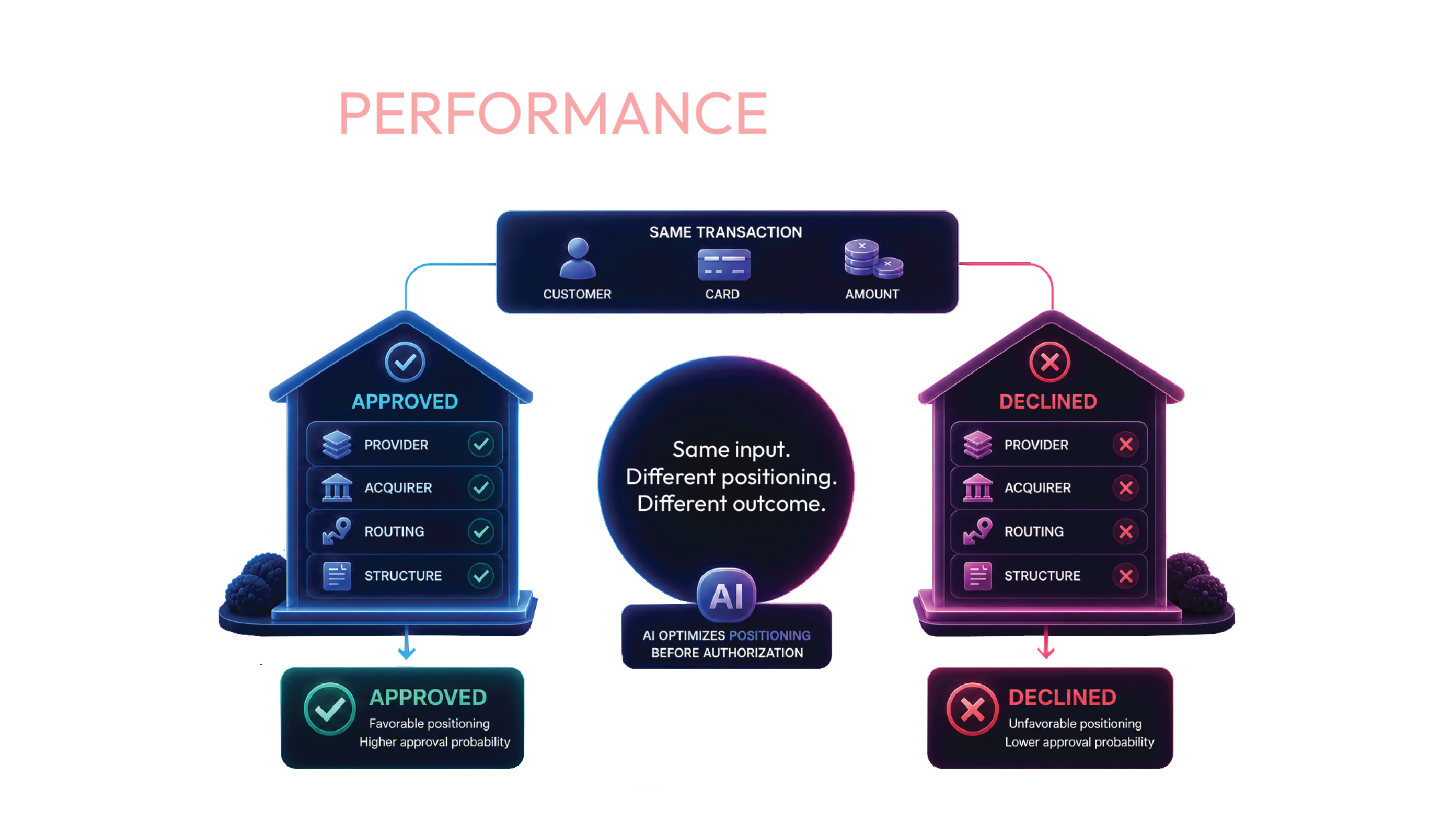
To understand the limitations of current AI applications in payments, it is necessary to examine where transaction outcomes are actually determined.
Long before a transaction reaches the issuer or card network, a series of upstream decisions has already defined its probability of success. These include the selection of the payment service provider, the choice of acquiring bank, the routing path across the payment infrastructure, and whether the transaction is processed locally or cross-border. Additionally, the way in which the transaction is structured and presented—its metadata, timing, and contextual signals—plays a critical role in how it will be interpreted during authorization.
Each of these variables contributes to the overall “positioning” of the transaction. This positioning determines how the transaction is perceived by downstream systems, including issuer risk engines and network, level decisioning frameworks.
In practical terms, this means that two transactions with identical surface characteristics: same customer, same card, same amount can produce materially different outcomes based solely on how they are routed and structured before authorization. One may be approved seamlessly, while the other is declined, not because of inherent risk, but because of differences in how it was presented to the system.
This is the point at which performance is truly created. Not at authorization, but before it.
Intelligence Without Execution
The rapid adoption of AI in payments has led to a proliferation of tools that provide enhanced visibility into transaction behavior. Businesses now have access to detailed analytics, predictive insights, and real, time monitoring capabilities that were previously unavailable. These tools can identify inefficiencies, highlight trends, and suggest areas for improvement.
However, visibility alone does not translate into impact.
The system may understand what is happening, but it lacks the ability to change the outcome.
This is where the illusion becomes most pronounced. The presence of intelligence creates the perception of control, but without execution, that control is limited. Organizations may believe they are optimizing their payment performance because they have access to advanced analytics, while in reality, the core decision making mechanisms remain unchanged.
The Missing Layer: Decisioning as Infrastructure
What is increasingly required is not additional layers of intelligence, but a redefinition of where intelligence is embedded within the payment stack. Specifically, intelligence must be integrated into the decision layer—the point at which transactions are constructed, routed, and prepared for authorization.
This layer determines how each transaction is positioned for success. It governs which provider is selected, how the transaction is submitted, whether it is processed locally or cross-border, and how retries are managed in the event of failure. It also balances competing variables such as approval probability, cost efficiency, and processing speed.
When intelligence is applied at this stage, it has the ability to influence outcomes directly. It moves from analysis to action, from observation to execution. AI becomes a tool not for interpreting results, but for shaping them.
In this context, decisioning is no longer a technical configuration. It becomes a core component of payment infrastructure.
From Optimization to Positioning

Historically, payment systems have been designed and optimized for execution. The primary objectives were reliability, scalability, and processing efficiency. Ensuring that transactions could be processed quickly and without interruption was the central focus.
While these objectives remain important, they no longer provide a meaningful competitive advantage. As infrastructure becomes more standardized and accessible, the ability to process transactions efficiently is increasingly assumed.
The differentiator has shifted.
Success in modern payments is less about execution and more about positioning. It is not enough to ensure that a transaction can be processed; it must be processed under the most favorable conditions. This requires systems that are not only robust, but also adaptive capable of continuously recalibrating decisions based on real-time signals across providers, markets, and issuers.
Positioning is what determines whether a transaction succeeds or fails in an increasingly complex and dynamic environment.
The Morefin Perspective: Intelligence That Drives Outcomes
At Morefin, this shift is not viewed as incremental, it is foundational. AI is not approached as a feature to be layered on top of existing systems, nor as a standalone capability designed to enhance visibility. Instead, it is embedded directly into the decision, making fabric of the payment flow.
The objective is to ensure that every transaction is positioned for success before it reaches authorization. This involves integrating intelligence into the mechanisms that govern routing, provider selection, and transaction structuring in real time.
In practice, this means dynamically selecting the optimal PSP and acquiring path based on live performance data, adapting instantly to changes in provider behavior, and continuously optimizing decisions across approval probability, cost, and speed. The system is not static; it evolves with each transaction, learning from outcomes and refining future decisions.
In this model, AI does not function as an analytical overlay. It operates as an execution engine. Its value lies not in predicting outcomes, but in actively shaping them.
This is where payments transition from passive processing to active performance management.
A More Demanding Ecosystem
The broader payments ecosystem continues to increase in complexity. Issuers are applying more stringent evaluation criteria, driven by evolving fraud patterns and regulatory requirements. Network level systems are becoming more sophisticated, incorporating a wider range of signals into their decision making processes. At the same time, customer expectations for seamless, instant payment experiences are higher than ever.
In such an environment, the margin for error narrows significantly. Transactions that are not optimally positioned are more likely to be declined, even if they do not present inherent risk. The tolerance for inefficiency decreases as systems become more precise and more interconnected.
This places greater emphasis on upstream decision making. It is no longer sufficient to rely on downstream systems to correct or compensate for suboptimal inputs. The quality of the initial decision becomes critical.
Conclusion
Artificial Intelligence will continue to play a central role in the evolution of payments. Its potential to enhance decision making, improve efficiency, and reduce risk is significant. However, the impact of AI will depend less on the sophistication of the models themselves and more on where they are applied within the transaction lifecycle.
The industry’s current focus on post authorization intelligence addresses only part of the problem. While it improves how transactions are evaluated, it does not address how they are constructed and positioned.
The greater opportunity lies upstream, in the decisions that define the conditions under which transactions are processed.
For organizations seeking meaningful improvements in payment performance, this requires a shift in perspective. The focus must move from analyzing outcomes to shaping them, from accumulating intelligence to operationalizing it within the decision layer.
Final Thought
The promise of AI in payments is not fulfilled by greater awareness or more advanced analytics. It is fulfilled by better decisions.
Until intelligence is fully integrated into the mechanisms that determine how transactions are executed, much of what is perceived as progress will remain constrained by its point of application.
And in that sense, the illusion will persist.

Let’s Build the Right
Flow for You
Ready to elevate your digital payments? Our team is here to tailor a custom, high-performance infrastructure that scales with your ambitions. Let’s build your next competitive advantage - together.