
Why Payment Orchestration Must Go Beyond Payins: The Strategic Importance of Payouts
For years, payment orchestration has focused predominantly on one side of the transaction: payins.
That focus made sense. Deposits are visible. They affect conversion immediately. When approval rates fall, the commercial impact is felt almost at once. As a result, the industry invested heavily in routing logic, retry flows, provider redundancy, and checkout optimisation.
All of that matters.
But it is still incomplete.
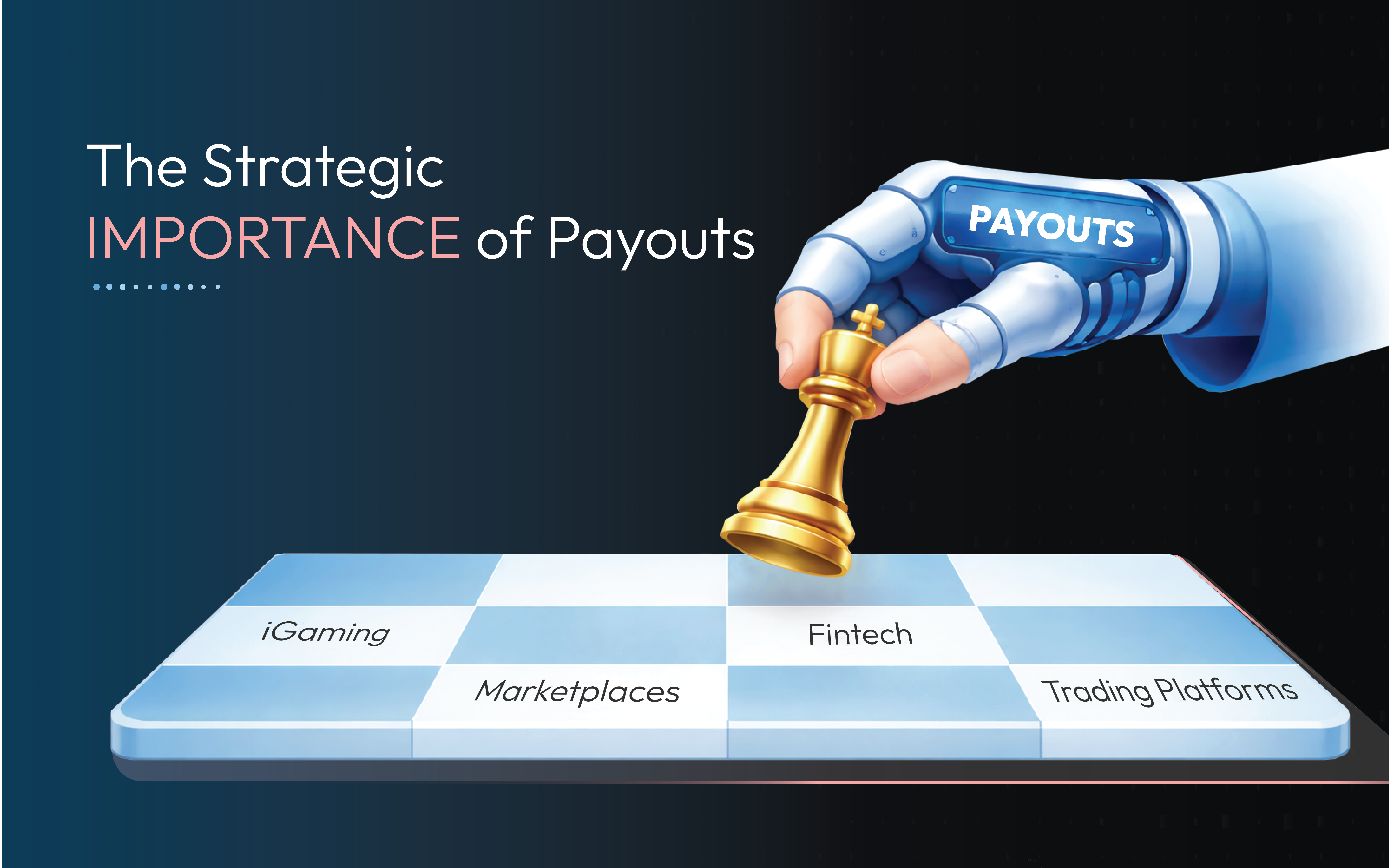
Because in high-frequency, high-volume environments such as iGaming, fintech, marketplaces, and trading platforms, the customer journey does not end with a successful deposit. It ends when funds can be paid out quickly, reliably, and without friction.
And this is precisely where many payment infrastructures continue to fall short.
From Payment Processing to Money Movement
Modern businesses are no longer simply processing payments. They are managing end-to-end money movement.
That means handling deposits, withdrawals, internal transfers, reconciliation, liquidity, and compliance as part of one connected system rather than a series of loosely related processes. The challenge is that many businesses have already modernised the payin side while leaving payouts on older, more fragmented logic.
The result is a structural imbalance. Money enters the system through an increasingly intelligent layer, but often leaves through a workflow that is slower, less flexible, and more dependent on manual intervention. For the business, that creates operational drag. For the user, it creates uncertainty at the exact moment when trust matters most.
Optimising only payins is not enough anymore. The question is no longer how to process transactions more efficiently on the way in. It is how to control the full movement of funds, in both directions.
Why Payouts Have Become a Strategic Growth Lever
Trust Is Earned at the Moment of Withdrawal
A successful deposit starts the relationship. A successful payout proves that the relationship is worth continuing.
That is why withdrawals carry a disproportionate amount of trust. Users may tolerate a little friction when funding an account. They are far less forgiving when they are trying to access their money. At that point, speed, clarity, and reliability are no longer nice-to-have. They are the experience.
A delayed or failed payout does more than create a support ticket. It changes how the business is perceived. It raises doubt, increases frustration, and makes the platform feel less dependable. In competitive sectors, that is often enough to push a user toward an alternative.
This is why leading businesses are beginning to treat payouts not as an operational necessity, but as a core part of the product experience.
Payout Friction Directly Impacts Revenue
Most businesses already understand the value of optimising deposits. They invest in approval rates, smart routing, intelligent retries, and provider resilience because every failed payin has an obvious effect on conversion.
Payouts do not always get the same level of attention, even though the downside is just as real.
When withdrawals are manual or semi-automated, limited to a narrow provider setup, or poorly adapted across markets and methods, the consequences show up elsewhere: in operational overhead, in support volumes, in user churn, and in weaker lifetime value. The cost is simply distributed across different parts of the business, which is why it is often underestimated.
That is what makes payout friction so expensive. It is not just an operations problem. It is a revenue problem that many businesses still measure too late.
Compliance Has Moved Closer to the Payout Flow
Payouts also carry more regulatory and procedural complexity than many businesses first expect.
Anti-money laundering controls, source-of-funds verification, method alignment, sanctions screening, and KYC-related checks increasingly sit closer to the withdrawal event itself. When these controls are handled outside the payout flow, the process becomes slower, less consistent, and more exposed to error.
A fragmented payout process usually means fragmented compliance. That creates two risks at once: legitimate users face unnecessary delays, while businesses lose control over how consistently their rules are being applied across providers, markets, and transaction types.
A strong orchestration layer changes that. It brings compliance closer to execution, making control more embedded and less reactive.
Treasury Efficiency Starts With Visibility
Payouts are not only a payment function. They are a treasury function as well.
Without orchestration, balances remain fragmented across providers, liquidity becomes harder to manage, and finance teams lose the ability to see cash positioning clearly in real time. The result is avoidable operational effort, higher FX costs, and slower decisions around where funds should move next.
Once payouts are treated as part of a unified money movement layer, that changes. Routing decisions can take account of balance availability, provider performance, and cost efficiency at the same time. Reconciliation becomes easier to manage. Liquidity becomes easier to position. Finance and payments begin operating from the same view of reality.
That is where orchestration starts creating value beyond the payments team.
Localisation Determines Performance at Scale
As businesses expand, payout expectations become more specific.
Different markets expect different withdrawal methods, different settlement speeds, and different fallback paths. A standardised payout setup may look efficient internally, but it rarely performs well across geographies.
What works for deposits does not always work for withdrawals. A user may fund an account one way and expect funds back through a different method. Some corridors demand instant local bank transfer support. Others rely more heavily on wallets, push-to-card flows, or region-specific alternatives. If the payout stack cannot adapt to those realities, the business ends up defaulting to slower and more expensive routes.
At scale, that becomes a commercial disadvantage.
The Hidden Complexity of Payouts
Payouts are inherently more complex than payins.
They require available funds, completed verification, risk and fraud checks, method eligibility, and operational readiness before the transaction can even be released. In many businesses, they also involve manual approvals or semi-automated interventions at exactly the points where consistency matters most.
That is why payouts cannot be treated as a simple extension of deposits. They need their own intelligence layer, their own decisioning logic, and their own operational discipline.
Without that structure, complexity turns into bottlenecks. Bottlenecks turn into delays. Delays turn into churn, higher costs, and weaker control.
What True Payment Orchestration Looks Like
A modern orchestration platform should treat payins and payouts as two parts of the same system, not as separate workflows that happen to sit inside the same stack.
That means routing logic should not stop at deposits. It should apply to withdrawals as well. Provider selection should not be static. It should be transaction-specific, based on market, method, performance, cost, and availability. Compliance should not sit outside the flow. It should be embedded into it. Reconciliation should not depend on manual assembly across dashboards and statements. It should be part of the operating model.
This is where MoreFin takes a different approach.
Most orchestration providers offer technology to help businesses manage payments. MoreFin combines payment technology, reconciliation, and payment operations in one fully managed in-house model. Instead of leaving businesses to coordinate multiple vendors, separate workflows, and fragmented reporting, MoreFin brings the full payment function under one operating layer built for performance, control, and speed.
That means one team overseeing how payments actually perform across both directions of money movement. It means integrations that move quickly, continuous optimisation across payment flows, and daily reconciliation instead of waiting days or weeks for a clear financial view. It also means the payment operation is not treated as a set of disconnected tools, but as a function that should actively improve conversion, visibility, and reliability over time.
That difference matters. Managing payment infrastructure is one thing. Running it well, every day, is something else entirely.
The Competitive Advantage
Businesses that orchestrate both payins and payouts effectively gain more than efficiency.
They improve approval performance. They reduce payout friction. They strengthen customer trust. They lower operational overhead. They gain better visibility into liquidity, reconciliation, and compliance. And they do all of that while creating a more resilient payment environment for future growth.
More importantly, they gain ownership over the payment experience as a whole.
That is becoming a serious competitive advantage. As user expectations rise and regulatory complexity grows, it is no longer enough to be strong only on the deposit side. The businesses that lead will be the ones that control the full flow of funds with the same level of intelligence on the way out as on the way in.
Final Thought
The industry is moving from payment processing to payment intelligence.
But real intelligence does not come from optimising one side of the transaction. It comes from having visibility, control, and operational ownership across the entire movement of money.
Payins initiate the relationship.
Payouts define whether it lasts.
And the businesses that will lead the next phase of the market will be the ones that understand a simple truth: you do not fully control payments until you control both directions of money.
FAQ
What is payout orchestration?
Payout orchestration is the intelligent management of withdrawals across providers, methods, geographies, and compliance rules. Instead of sending every payout through a fixed provider setup or a manual queue, it uses decisioning logic to choose the most appropriate route for each transaction based on performance, cost, market requirements, and operational conditions.
What is the difference between payin and payout orchestration?
Payin orchestration focuses on inflows such as deposits and checkout performance. Payout orchestration focuses on outflows such as withdrawals and disbursements. The core logic may look similar, but the business impact is different. Payin failures affect conversion immediately. Payout failures tend to show up later through churn, support pressure, reconciliation delays, and weaker trust.
Why do payouts fail more often than payins?
In many businesses, payout infrastructure is less mature. It often has fewer providers per corridor, less dynamic routing, more manual intervention, and more points where compliance or operational checks can create delays. As a result, payouts are frequently handled with less flexibility and less intelligence than the deposit side.
How does payment routing work for payouts?
Payout routing applies decisioning logic at the moment a withdrawal is initiated. It evaluates factors such as destination market, payment method, provider performance, cost, and available balances, then selects the most appropriate route for that specific transaction. In a more advanced setup, fallback logic can also redirect payouts if the primary path underperforms or fails.
How do compliance checks fit into payout flows?
The strongest model is to embed compliance directly into the payout flow. That means checks related to AML, KYC alignment, sanctions screening, or source-of-funds requirements are triggered as part of the withdrawal decision itself rather than handled separately later. This improves both speed and control.
Why do payout delays increase churn?
Because withdrawals are the moment when users expect certainty. A delayed payout creates more frustration than a delayed deposit because it affects access to funds rather than access to the product. That changes how the platform is perceived and increases the likelihood that users will look for alternatives, especially in competitive sectors.
How does automated reconciliation relate to payouts?
Every payout creates multiple records across the payment provider, the business, and the financial reporting layer. Without automated reconciliation, teams often have to match those records manually, which slows reporting and increases the chance of errors. A unified reconciliation process helps businesses track whether funds moved correctly, when they settled, and where action is needed.
What makes MoreFin different?
MoreFin combines payment technology, reconciliation, and payment operations in one fully managed in-house model. Rather than giving businesses another tool to manage, MoreFin helps them run the full payment function with stronger control over performance, clearer financial visibility, faster operational response, and less dependency on multiple external parties.
Related articles


Let’s Build the Right
Flow for You
Ready to elevate your digital payments? Our team is here to tailor a custom, high-performance infrastructure that scales with your ambitions. Let’s build your next competitive advantage - together.