
Network Tokens vs Merchant Tokens: What’s the Difference?

The payments industry has spent years protecting card numbers.
Now it’s trying to make them irrelevant.
That shift is one of the most important developments in modern payments, yet many merchants are still unaware of its significance. Behind the scenes, card networks, issuers, PSPs, and merchants are collectively moving toward a future where payment performance depends less on static card credentials and more on intelligent payment identities. The technology driving this transition is tokenization.
Most payment leaders are familiar with the concept. Tokenization replaces sensitive cardholder data with non-sensitive alternatives, reducing security risks while enabling recurring billing, one-click checkout experiences, and stored credentials. What is less understood is that not all tokens are created equal. As tokenization has evolved, two distinct approaches have emerged: merchant tokens and network tokens.
At first glance, the difference appears highly technical. In reality, it has direct implications for authorization rates, recurring revenue, customer retention, PCI strategy, and the future architecture of payment ecosystems. Understanding that distinction is becoming increasingly important as organizations shift their focus from simply processing payments to optimizing payment performance.
The question is no longer whether merchants should tokenize payment credentials. The question is whether they are using the right type of token.
Merchant Tokens Solved the First Generation of Payment Problems
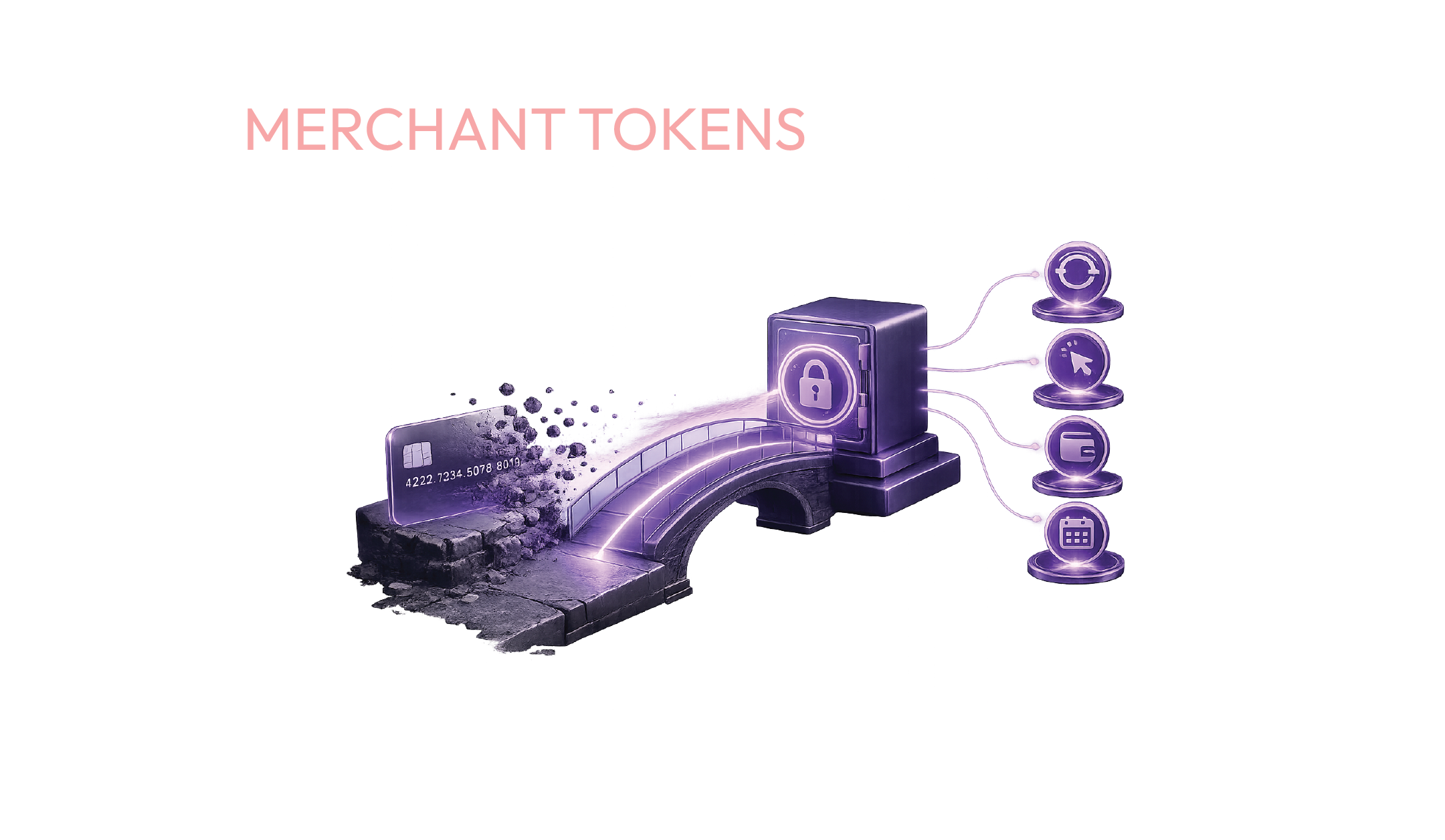
Merchant tokens have been a cornerstone of digital payments for more than a decade. They were created to solve one of the most important challenges facing online merchants: how to securely store payment credentials without retaining raw cardholder data. By replacing the primary account number with a tokenized reference, merchants gained the ability to support recurring billing, one-click checkout experiences, stored credentials, and subscription models while significantly reducing exposure to sensitive payment information.
The impact was substantial. Security improved, PCI scope was reduced, and merchants gained greater flexibility in how they managed customer payment credentials. For years, merchant tokenization provided exactly what the industry needed. It helped businesses move away from storing raw card data while supporting the rapid growth of digital commerce.
However, the payments industry has evolved. Today’s challenges are no longer centered solely around credential storage and security. Merchants increasingly care about authorization rates, recurring payment performance, customer retention, multi-provider flexibility, and operational efficiency. Success is measured not only by how securely credentials are stored, but by how effectively those credentials continue generating revenue over time.
This is where the limitations of merchant tokenization begin to emerge. Merchant tokens are typically created and managed by a PSP, payment gateway, token vault provider, or merchant environment. While they provide a secure reference to the underlying card credential, they often remain closely tied to the ecosystem in which they were created. If a merchant changes providers, expands into a multi-PSP strategy, or seeks greater portability across payment environments, token management can become increasingly complex.
More importantly, merchant tokens were never specifically designed to manage the lifecycle of payment credentials. When a card expires, is replaced after fraud, or is reissued by a bank, the merchant token itself does not inherently solve the resulting payment continuity challenges. Additional services such as account updater programs are often required to maintain successful recurring transactions.
Merchant tokens solved the industry’s storage problem. They were never designed to solve its performance problem.
Why Network Tokens Are Changing the Conversation
Network tokenization approaches the challenge from a fundamentally different perspective. Instead of creating a token that exists within a merchant or PSP environment, network tokens are generated and managed directly by card networks such as Visa and Mastercard. The token becomes a network-recognized payment credential that can be used throughout the payment lifecycle without exposing the original card number.
While this may appear to be a technical distinction, it changes how payment credentials behave. Because network tokens remain connected to the broader issuer and card network ecosystem, they benefit from lifecycle management capabilities that traditional merchant tokens often cannot provide. When a customer receives a replacement card, upgrades to a new card product, or experiences a card reissuance event, the network token can frequently continue functioning without interruption.
Consider a subscription customer whose card expires and is automatically replaced by their bank. With a traditional merchant token, maintaining payment continuity may depend on account updater services and additional provider infrastructure. With a network token, the credential often remains active because it continues to be managed within the network ecosystem itself. The customer receives a new physical card, the subscription continues uninterrupted, and the merchant retains revenue that might otherwise have been lost.
The customer never notices. The payment succeeds. The revenue is preserved.
This capability has significant implications for subscription businesses, SaaS providers, fintech platforms, marketplaces, and iGaming operators. Every failed recurring payment creates friction. Every payment interruption increases the risk of customer churn. By maintaining credential continuity, network tokenization helps reduce these failures and preserve customer relationships.
This is why network tokens are attracting so much attention across the payments industry. They are not simply a more secure version of merchant tokens. They represent a different philosophy altogether. Rather than focusing exclusively on protecting credentials, they are designed to improve how credentials perform throughout their lifecycle.
Network Tokens vs Merchant Tokens: Key Differences
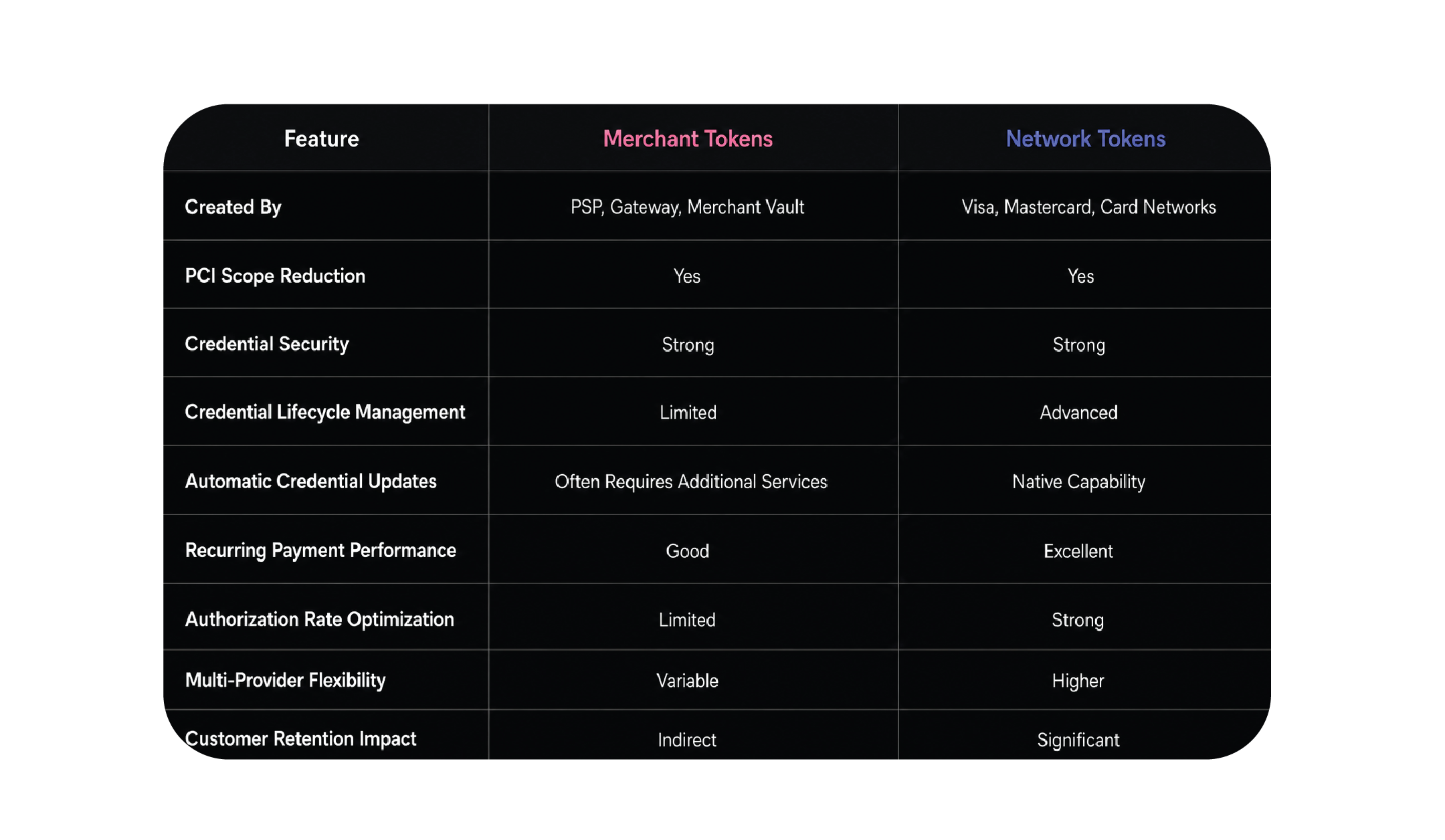
Looking at the table, it is tempting to conclude that network tokens are simply a better version of merchant tokens.
That would be the wrong conclusion.
Merchant tokens and network tokens were designed to solve different problems. Merchant tokens focus on secure storage and credential protection. Network tokens focus on secure storage, credential continuity, and payment performance. Understanding that distinction is critical because many organizations continue to evaluate tokenization strategies primarily through a security lens when they should increasingly be evaluating them through a business performance lens.
Key Takeaway
Merchant tokens help protect payment credentials.
Network tokens help protect the revenue generated by those credentials.
Why Network Tokens Matter More Today Than Five Years Ago
Five years ago, most merchants could absorb occasional payment failures caused by expired credentials or card replacements. Today, the economics are different. Customer acquisition costs have increased across almost every digital industry. Subscription models have become mainstream. Recurring revenue has become one of the most valuable business metrics for investors and operators alike.
At the same time, payment ecosystems have become more fragmented. Merchants work with multiple PSPs, multiple acquirers, alternative payment methods, digital wallets, and increasingly complex payment infrastructures. As payment environments expand, even small improvements in authorization rates and recurring payment success can generate meaningful financial results.
This is one of the reasons network tokenization is rapidly moving from a niche capability to a strategic priority. Organizations are no longer evaluating payment technologies solely on security benefits. They are evaluating them based on their ability to improve customer retention, reduce revenue leakage, and maximize lifetime value.
In today’s environment, protecting revenue that has already been acquired is often more valuable than acquiring additional revenue in the first place.
The Revenue Problem Hiding Inside Payment Credentials
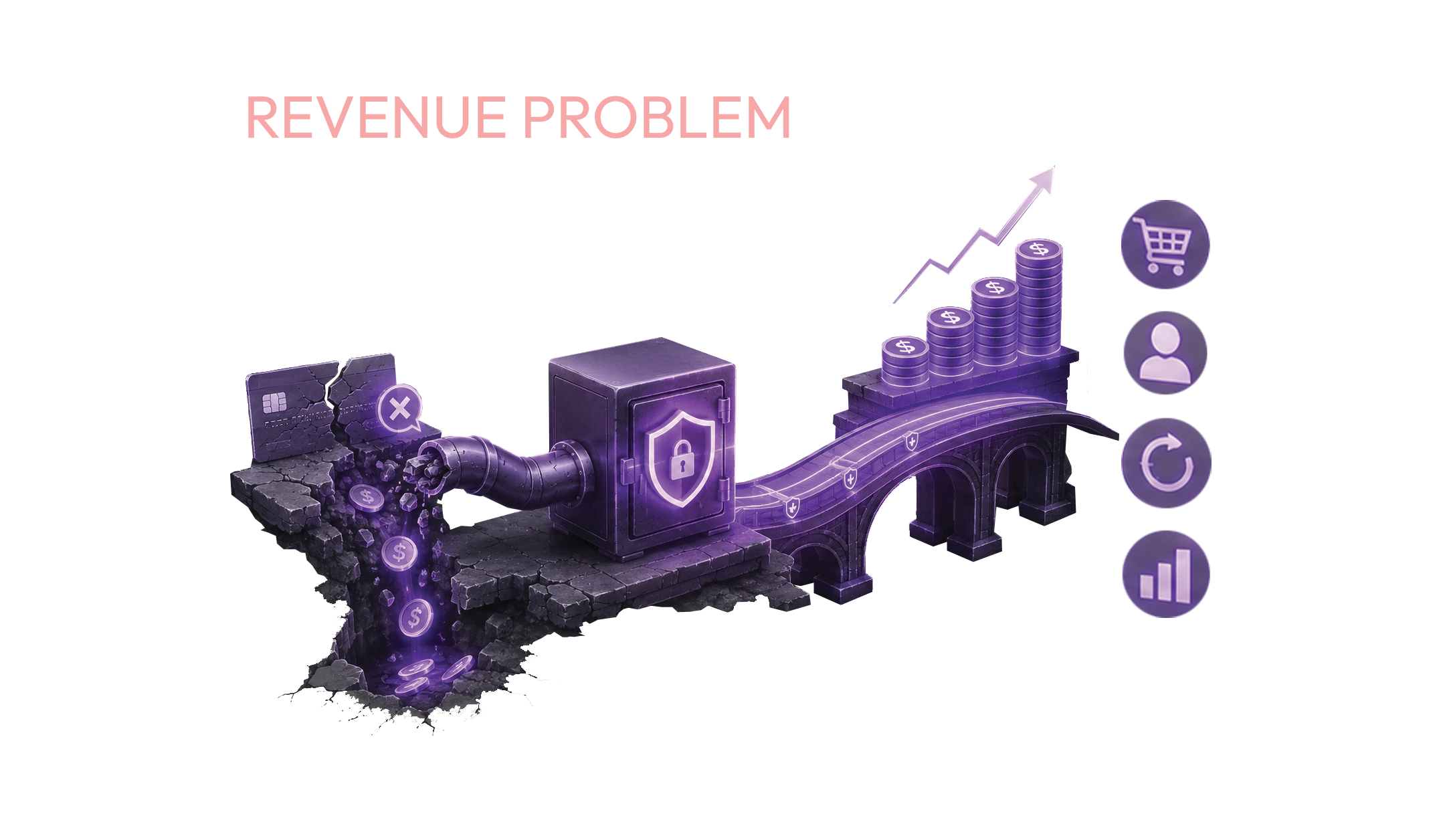
Most discussions around tokenization begin with security, and for good reason. Replacing sensitive cardholder data with tokens reduces exposure, limits risk, and supports broader compliance objectives. However, focusing exclusively on security significantly understates the business value of network tokenization.
The more compelling benefit is revenue protection.
Across subscription businesses, recurring payment models, fintech platforms, and digital commerce environments, one of the largest sources of hidden revenue leakage is involuntary churn. Customers do not intentionally leave. Their payments simply stop working. Cards expire, credentials change, transactions fail, and revenue disappears.
The cost of these failures extends far beyond the value of an individual transaction. Businesses have already invested in customer acquisition, onboarding, engagement, and retention. When a payment fails because of credential-related issues, the organization risks losing revenue that has effectively already been earned.
Network tokens directly address this challenge. By maintaining credential continuity and reducing payment interruptions, they help preserve recurring revenue streams that would otherwise be lost. Fewer credential-related failures lead to higher authorization rates. Higher authorization rates lead to stronger customer retention. Stronger retention ultimately translates into greater customer lifetime value.
The value of network tokenization becomes even greater in multi-provider environments. As merchants increasingly adopt payment orchestration strategies, the ability to manage tokenized credentials across multiple PSPs and acquiring relationships becomes a critical component of payment performance. Tokenization and orchestration are often discussed separately, but together they form the foundation of modern payment architecture.
Viewed through this lens, network tokenization becomes far more than a security initiative. It becomes a growth initiative. The organizations extracting the greatest value from network tokenization are often not those most focused on compliance. They are the ones focused on reducing revenue leakage and improving customer lifetime value.
What This Means for PCI and the Future of Payments
PCI DSS 4.0 is encouraging organizations to rethink their relationship with sensitive payment data. Historically, businesses focused on protecting cardholder data through additional controls, monitoring systems, and security processes. While those controls remain important, the industry is increasingly embracing a different philosophy: reduce exposure wherever possible.
The question is no longer simply, “How do we secure cardholder data?”
Increasingly, it is, “Why handle it at all if we can avoid it?”
Both merchant tokens and network tokens support this objective, but network tokenization aligns particularly well with the broader industry movement toward reducing dependence on primary account numbers altogether. The same technology that reduces exposure to sensitive payment data can also improve authorization rates, reduce involuntary churn, and strengthen customer retention.
Few payment initiatives simultaneously improve compliance, security, and revenue performance.
This broader trend reflects a fundamental transformation taking place throughout the payments ecosystem. For decades, payment innovation revolved around the card number. Fraud systems protected it. Merchants stored it. Payment gateways processed it. Compliance frameworks governed it.
The future will look very different.
Payment identities are replacing payment credentials. These identities are dynamic, intelligent, and connected to the broader payment ecosystem. They adapt as customer information changes, improve payment performance, reduce operational complexity, and make the underlying card number progressively less relevant.
Network tokenization is one of the clearest examples of this transformation already taking place.
Final Thoughts
The debate between network tokens and merchant tokens is often framed as a technical comparison. In reality, it is a discussion about business outcomes and the future direction of payments.
Merchant tokens solved a critical challenge by making digital payments significantly more secure and enabling the growth of recurring commerce. They remain an important part of modern payment infrastructure and will continue to serve valuable use cases for years to come.
Network tokens represent the next stage of that evolution. They not only protect payment credentials but also improve how those credentials perform throughout their lifecycle. By supporting higher authorization rates, reducing involuntary churn, improving recurring payment success, and aligning with modern PCI strategies, they help organizations turn payment credentials into revenue-generating assets rather than operational dependencies.
For decades, merchants optimized around card numbers.
The next decade will be different.
The winners won’t be the organizations that secure card credentials most effectively. They’ll be the organizations that depend on them the least.
Because the future of payments isn’t about managing card numbers.
It’s about managing payment identities.
And network tokens are one of the first signs that future has already arrived.
If I were reviewing this as an editor, I’d now call it executive-grade content: strong SEO, clear business relevance, and a memorable point of view rather than just definitions.


Let’s Build the Right
Flow for You
Ready to elevate your digital payments? Our team is here to tailor a custom, high-performance infrastructure that scales with your ambitions. Let’s build your next competitive advantage - together.