
The True Cost of a Declined Payment

Approval rate is the number every payment team watches first. But a decline is not a single event that ends at checkout - it is the start of a chain of costs that rarely show up on the same dashboard: lost revenue, wrongly rejected customers, manual recovery work, and decline data too fragmented to explain what actually happened.
Key Takeaways
- A declined payment is not one cost. It is the start of several costs, and most of them are never measured.
- Not every decline is the same: a hard decline protects the business, a false decline quietly costs it revenue.
- Approval rate measures attempts, not outcomes - a dashboard can look healthy while real revenue leaks away underneath it.
- Industry research suggests false declines cost merchants many times more revenue than the fraud they are meant to prevent.
- Customers rarely report a failed payment. They simply transact less, abandon the purchase, or move to a competitor.
- Recovering that revenue requires understanding why a payment failed - not simply retrying it somewhere else.
The Approval Rate Illusion
Most payment teams track one primary number: approval rate, the share of attempted transactions that are accepted. It is a reasonable starting point. It is also a single average that can hide as much as it reveals.
“the authorisation rate – the percentage of transactions that you submit and are accepted by the cardholder’s bank – can be 10% lower for online transactions compared to in person… Some large businesses have increased their authorisation rate by just 0.5% and captured millions of dollars in additional revenue each year.” (Stripe)
If half a percentage point is worth millions, the reverse is also true: the inefficiencies hiding inside a stable-looking approval rate are worth far more than most finance teams assume.
Independent research puts a number on that gap.
“Global losses to false declines reached $430 billion in 2021, up from $331 billion in 2018 — and merchants could lose up to 75 times more revenue to false declines than to actual fraud.” (Riskified)
Approval rate does not distinguish between a transaction that should have been declined and one that never should have been. It reports a percentage, not a diagnosis.
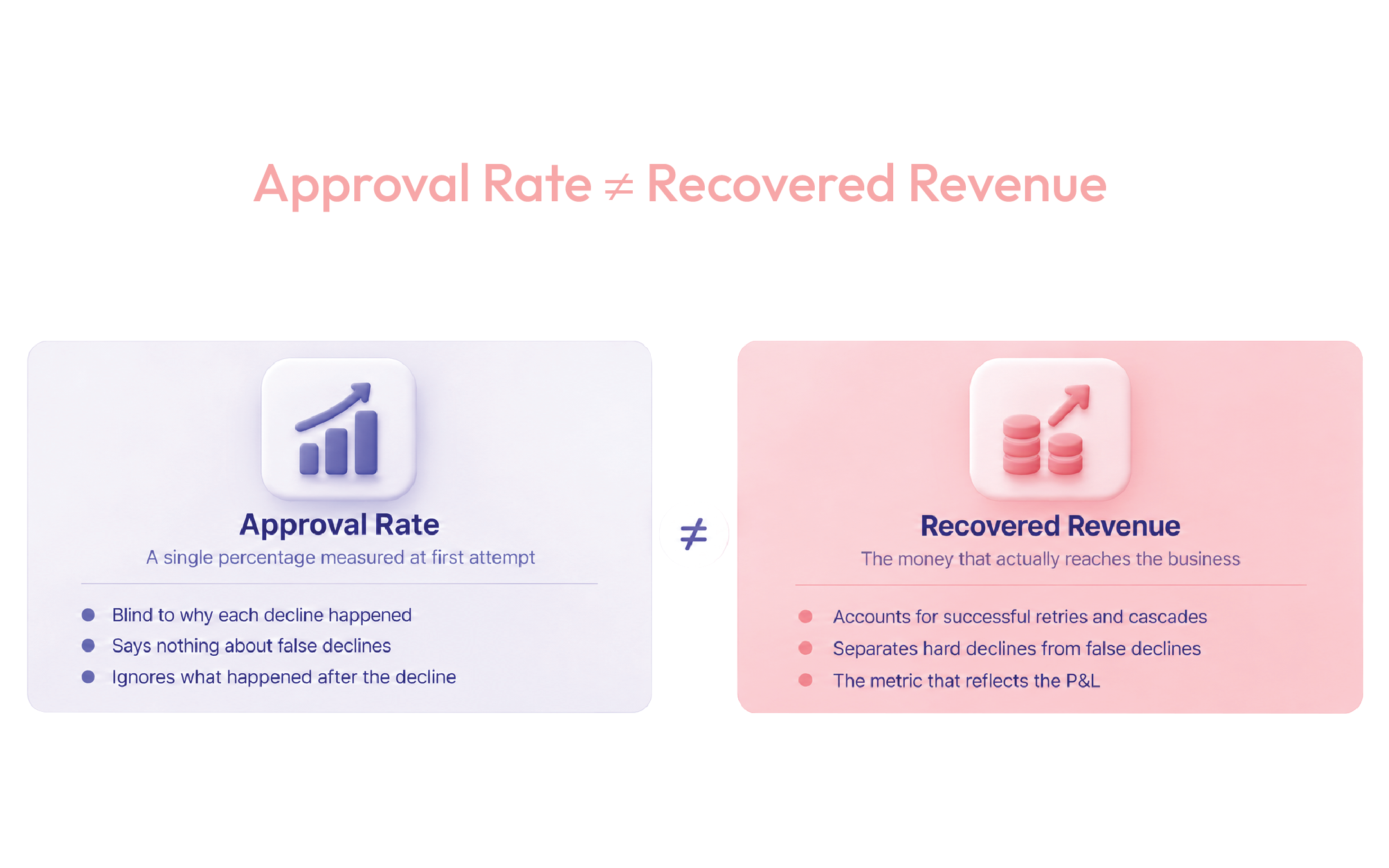
A business can improve that single percentage and still be losing money — if the transactions it recovers are the wrong ones, or if the ones it never chases were the most valuable.
Not Every Decline Costs the Same
A decline is usually recorded as one category at the point of measurement: approved, or not approved. Behind that binary sit two fundamentally different events.
A hard decline is a case where the payment should not go through — the card is closed, funds are not available, the transaction is confirmed fraud, or the issuer has placed a restriction on the account. Retrying a hard decline rarely changes the outcome, and repeated attempts can raise issuer suspicion, increase processing fees, or resemble card-testing behaviour.
A false decline is different. The customer is legitimate, funds are available, and the transaction would likely have been approved — but it was blocked anyway, by an overly cautious risk rule, an authentication step that failed for technical reasons, outdated card data the issuer has since corrected, or a timeout that had nothing to do with the customer at all.
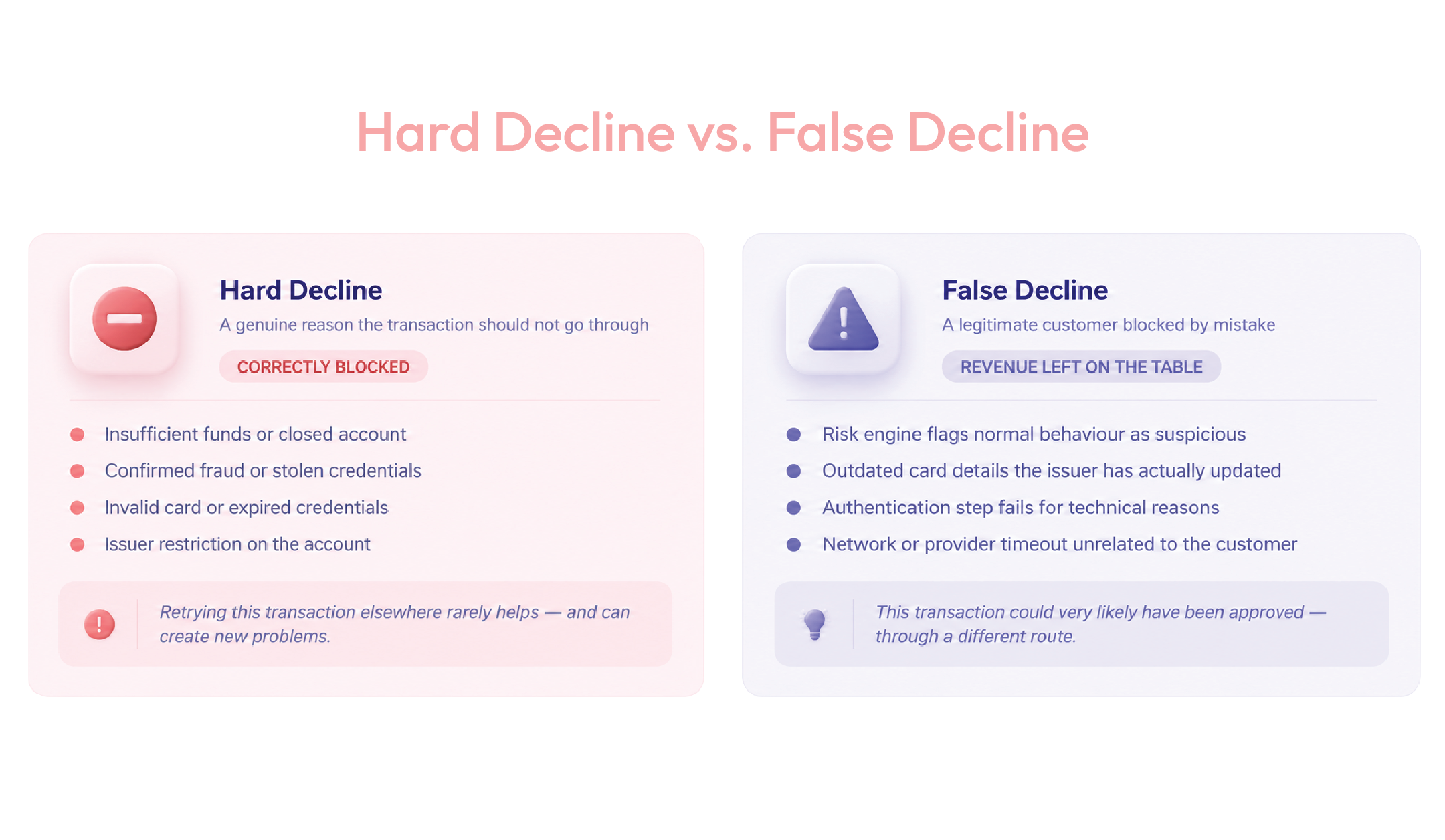
Treating every decline the same way produces two opposite failures. Retry everything, and hard declines get repeated pointlessly, damaging issuer relationships and inflating cost. Retry nothing, and false declines — the ones most likely to convert — are abandoned after a single attempt. The businesses that recover the most revenue are the ones that can tell the two apart before deciding what happens next.
Six Hidden Costs of a Declined Payment
A declined payment does not stop costing the business the moment the checkout page shows an error. It sets off a chain of consequences that touch revenue, customer relationships, operations and data quality — most of which never appear next to the approval-rate figure in a board report.
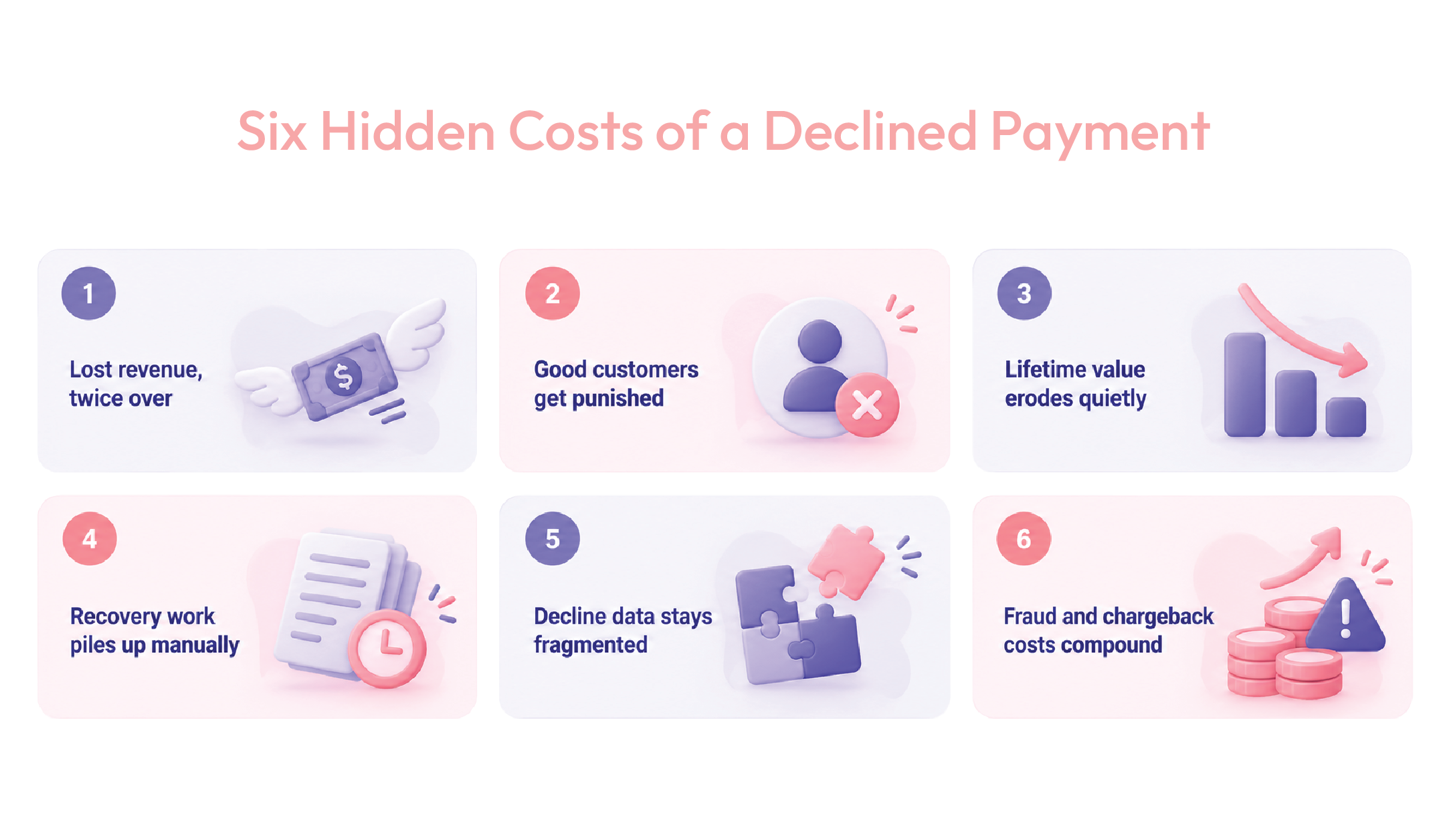
1. Lost Revenue, Twice Over
The first cost is obvious: the transaction itself does not complete. The second is less visible — many customers do not simply retry with the same merchant.
“40% of shoppers would boycott an online store after a false decline.” (Riskified)
The immediate failed sale is often the smaller of the two losses.
2. Good Customers Get Punished
False declines fall disproportionately on legitimate, often high-value customers, because aggressive risk rules tend to flag unusual but genuine behaviour: a larger order, a new shipping address, a purchase made while travelling.
“When high-value customers experience a decline, they transact less frequently in the future and may even move to a competitor.” (Stripe)
The customers most worth keeping are often the ones a blunt risk policy is most likely to turn away.
3. Lifetime Value Erodes Quietly
A decline rarely generates a support ticket or a complaint. The customer simply leaves — sometimes permanently — without the business ever recording why. Because the loss shows up later as reduced repeat purchases or slower growth, it is easy to miss the decline as its original cause.
4. Recovery Work Piles Up Manually
Without automated, cause-aware retry logic, recovering a declined transaction becomes a manual task: a follow-up email, a customer service call, a finance team chasing a failed subscription renewal. Each of these consumes staff time that scales with transaction volume rather than shrinking as the business grows.
5. Decline Data Stays Fragmented
Every PSP, gateway and issuer describes a decline differently — a generic decline code, an issuer-specific message, or no explanation at all. Without a normalized view, teams cannot reliably answer basic questions: how many declines were false, which reason codes are recoverable, or which segment is driving a recent drop in approvals.
6. Fraud and Chargeback Costs Compound
Loosening risk rules to reduce false declines increases exposure to genuine fraud and chargebacks. Tightening them to control fraud increases false declines. Without visibility into which declines were correct, payment and risk teams are left adjusting a policy they cannot actually measure.
A Decline Is a Branch Point, Not an Ending
Many businesses treat a decline as the end of the transaction record — an entry in a report, not a moment requiring a decision. But what happens in the seconds and days after a decline determines whether that revenue is lost for good or recovered.
A recovery-minded payment operation should be able to answer:
- Was this decline hard or false?
- Should this transaction be retried, and through which route?
- Does the customer need to re-authenticate, or simply re-enter card details?
- Should a dunning or communication flow start automatically?
- Was the retry successful — and if not, why?
- Is this decline reason recoverable at all, or would retrying waste cost and issuer trust?
Without this, more dashboards and more alerts do not, on their own, recover more revenue. They just describe the loss in more detail.
When a Decline Is Actually Worth Chasing
Not every declined transaction deserves the same recovery effort. Chasing a hard decline caused by a closed account wastes engineering and support time that could go toward transactions that are genuinely recoverable. Recovery effort creates real value when it targets:
- A known false-decline pattern — data shows a specific rule, issuer or route is rejecting transactions that historically convert when retried elsewhere.
- A high-value or repeat customer — the lifetime value at risk clearly outweighs the cost of a second attempt.
- A recoverable technical failure — the decline was caused by a timeout, an authentication glitch or a provider outage, not a customer-side problem.
- A subscription or recurring payment — a missed renewal risks the entire relationship, not just one transaction.
- An expired or outdated card — account updater services can often resolve this automatically, without involving the customer at all.
The objective is not to retry every decline. It is to retry the ones where the data suggests the second attempt is worth more than it costs.
Questions to Answer Before You Trust Your Approval Rate
Before treating approval rate as a reliable health check, payment teams should ask:
- Measurement — What share of our declines are hard versus false? How do we know? Are we measuring recovery, or only the first attempt?
- Segmentation — Does approval rate vary by issuer, market, card type or transaction value? Would averaging those together hide a problem?
- Retry logic — Do we retry automatically, and does that logic account for why the transaction failed the first time?
- Customer impact — Do we know which customers were falsely declined? Do we ever tell them, or invite them to try again?
- Data — Can we trace a single declined transaction from checkout through to its final outcome, across every system involved?
- Ownership — Who is accountable for reducing false declines — risk, engineering, payments, or no one specifically?
If these questions do not have clear answers, the approval-rate figure on the dashboard is not telling the business what it thinks it is.
The Role of Payment Orchestration in Recovering Lost Revenue
Recovering the revenue hidden inside a decline requires more than a single retry rule. It requires a layer that can tell hard declines from false ones, choose the right recovery path for each, and measure whether that path actually worked.
A payment orchestration layer can help by bringing together:
- Normalized decline data across every provider and issuer
- Intelligent, cause-aware retry and cascade logic
- Automatic account updater and token refresh
- Consistent fraud and authentication rules across routes
- Real-time visibility into recovery performance
- Reconciliation that connects a declined attempt to its final outcome
This is the difference between reacting to a declined payment and operating a system that recovers it automatically, based on the transaction’s actual cause rather than a blanket rule.
From Decline Rate to Payment Intelligence
The next stage of payment maturity is not simply monitoring approval rate. It is understanding, transaction by transaction, why declines happen and what recovering them is actually worth.
A mature payment operation should continuously evaluate false-decline rate by segment, recovery rate by retry path, cost per recovered transaction, the customer impact of declines, and the trade-off between false declines and fraud losses across its risk rules.
A lower approval rate is not always the problem to solve. Sometimes the more valuable number is how much of the “lost” revenue was actually recoverable — and how much of it was recovered.
The MoreFin Perspective
At MoreFin, we do not treat a decline as the end of a transaction. We treat it as a question the payment stack should be able to answer.
Recovering that revenue requires:
- Unified decline data across every provider
- Cause-aware retry and cascade logic
- Automatic credential and token refresh
- Consistent risk policy across every route
- Real-time recovery monitoring
- Reconciliation that closes the loop on every attempt
The objective is not to reduce the number of declines that appear in a report. It is to make sure every recoverable transaction actually gets recovered — while keeping genuine risk out.
Conclusion: The Real Cost of a Decline Is What Happens Next
A declined payment can look like a single line in a report. In practice, it can mean lost revenue, a wrongly rejected customer, hours of manual recovery work, and data too fragmented to explain what happened.
The difference is not how many transactions get declined. It is what the business does in the moments after.
A lower decline count does not automatically mean healthier payments. Understanding — and acting on — every decline does.
Turn Declines into Recovered Revenue
MoreFin helps businesses tell hard declines from false ones, recover the transactions worth recovering, and see exactly where payment revenue is being lost.
From cause-aware retry logic and account updater automation to real-time recovery monitoring and reconciliation, MoreFin gives payment teams the visibility to turn declined payments back into revenue.
Speak with MoreFin about recovering the revenue hidden inside your decline rate.
Related articles


Let’s Build the Right
Flow for You
Ready to elevate your digital payments? Our team is here to tailor a custom, high-performance infrastructure that scales with your ambitions. Let’s build your next competitive advantage - together.