
Stablecoin Payments for Merchants
Key Takeaways
• Stablecoins are digital assets designed to maintain a stable value, but the issuer, reserve model, blockchain and redemption process still matter.
• The customer payment and the merchant settlement are separate decisions. A buyer can pay with a stablecoin while the merchant receives fiat.
• Faster onchain transfer does not solve wallet security, compliance screening, conversion, refunds, accounting or customer support.
• Stablecoins have the clearest commercial fit in cross border settlement, digital asset markets, global payouts and always on treasury operations.
• Merchants should compare total cost, conversion, settlement time, liquidity and exception handling rather than blockchain fees alone.
• Payment orchestration can place stablecoins beside existing methods without creating a separate view of routing, risk and financial performance.
Stablecoins Are Becoming Payment Infrastructure
Stablecoins began as a way to move stable value between digital asset platforms. Their role is expanding. Payment providers, card networks, fintechs and merchants are now using them for settlement, cross border transfers, payouts and checkout acceptance.
Visa reported in April 2026 that its stablecoin settlement pilot had reached a 7 billion dollar annualized run rate after growing 50 percent quarter over quarter. The company also expanded the pilot across additional blockchains and stablecoins.
Visa describes stablecoins as part of its settlement and money movement infrastructure rather than only a consumer payment method. (Visa)
Merchant access is widening as well. Stripe and Shopify announced stablecoin acceptance for merchants in 34 countries, with merchants able to receive their preferred local currency by default. The customer can use a stablecoin without forcing the merchant to hold one.
That model shows the central distinction in stablecoin commerce: the asset used at checkout does not have to be the asset received in settlement. (Stripe)
The opportunity is real, but the useful question is not whether stablecoins are faster than traditional rails. It is whether they produce a controlled payment outcome for the merchant at a lower total cost or with better customer reach.

What Makes a Stablecoin Stable
A stablecoin is a digital asset designed to track the value of another asset, commonly a national currency such as the US dollar or euro. The design may use reserves, overcollateralization or other mechanisms. Those structures do not carry the same financial or operational risk.
For merchant payments, the label stablecoin is therefore too broad. A business must know who issues the asset, what supports its value, how redemption works, which entities provide custody and conversion, and whether the asset is permitted in the relevant market.
Circle states that USDC can be redeemed one for one for US dollars by eligible customers and supports payment and settlement use cases across its network. That claim is specific to USDC and its issuer structure; it should not be applied automatically to every stablecoin. (Circle)
The blockchain matters separately. The same stablecoin can exist on several networks with different fees, confirmation times, liquidity and operational support. A correct token sent on the wrong network can still create a serious recovery problem.
Seven Decisions Behind Stablecoin Acceptance
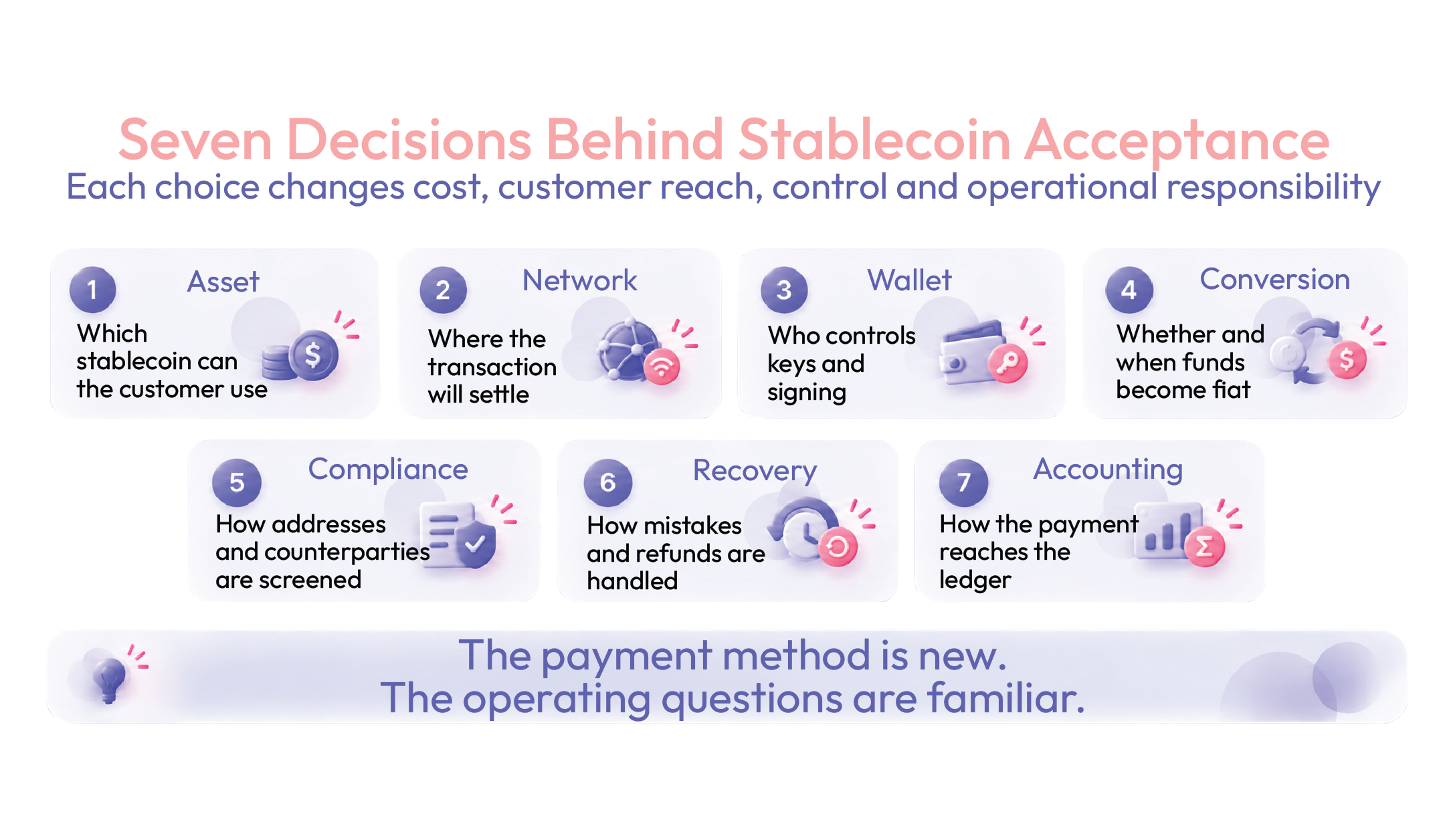
1 Choose the Asset Before Advertising the Payment Method
Customers need to know exactly which stablecoins are accepted. The merchant needs a policy for issuer quality, redemption, liquidity, geographic availability and concentration risk. Accepting every asset that calls itself stable increases reach on paper and expands operational exposure in practice.
A controlled launch usually starts with a narrow list of assets whose settlement and conversion paths are already supported. The policy should also define what happens if an asset loses its expected value or a provider suspends conversion.
2 Treat the Network as Part of the Payment Method
Token and network form one payment instruction. USDC on one blockchain is operationally different from USDC on another. Wallet addresses, confirmation rules, transaction fees and provider support can vary.
Checkout should prevent ambiguity. The displayed destination, supported network and amount must agree. Monitoring should confirm the correct asset, chain and value before the order is released. Manual recovery should be the exception, not the normal response to unclear payment instructions.
3 Decide Who Controls the Wallet
A merchant can manage wallets directly or use a provider that abstracts custody and signing. Direct control can offer flexibility, but it also creates responsibility for private keys, permissions, transaction approval and recovery. A managed model reduces some operational work and introduces provider dependency.
The choice should follow treasury and security requirements rather than ideology. Teams need clear rules for who can move funds, which destinations are permitted, how limits are enforced and what happens when access is lost or compromised.
4 Separate Acceptance from Treasury Exposure
Accepting stablecoins does not require keeping them. A provider can convert the customer payment and settle fiat into the merchant bank account. Another merchant may retain part of the balance for supplier payments, treasury transfers or digital asset operations.
The decision changes liquidity, accounting and risk. Automatic conversion can simplify finance but add spreads and provider fees. Holding stablecoins can reduce repeated conversion for onchain use cases but creates wallet, issuer and concentration exposure. The business should define the settlement asset before launching the checkout option.
5 Build Compliance into the Flow
Stablecoin transactions are visible on a blockchain, but visibility is not the same as a compliance decision. Merchants and their providers may need sanctions screening, wallet risk checks, customer identification, transaction monitoring and controls that reflect the jurisdiction and business model.
Rules also differ by market. In the European Union, the Markets in Crypto Assets Regulation provides a harmonized framework for crypto assets, issuers and related service providers. It has been fully applicable since December 2024, but the obligations relevant to a merchant still depend on the service structure and the parties involved.
The European Commission describes MiCA as the EU framework for crypto assets and related services that are not covered by other financial services legislation. (European Commission)
6 Design Refunds Before the First Sale
Blockchain transfers are generally not reversed through the same process used for card chargebacks. That changes error handling; it does not eliminate the need for refunds or consumer support.
The merchant must decide whether a refund is returned in the original stablecoin, at the original value or at the current fiat equivalent. It also needs a verified destination, an approval process and a policy for network fees. These decisions become difficult when the customer paid from an exchange or custodial wallet that does not support inbound returns in the expected way.
7 Connect Onchain Activity to the Ledger
A blockchain transaction hash proves that a transfer occurred. Finance still needs to know which customer order it belongs to, the fiat value at the relevant time, any network or conversion fees, and the amount ultimately settled into the merchant account.
Without that link, stablecoins create a parallel finance process. Payment teams see wallet activity, treasury sees balances and finance sees conversion or bank entries. Reconciliation must connect those records into one economic result.
Stablecoin Payments and Card Payments Solve Different Problems
Cards provide broad consumer familiarity, established dispute processes and mature recurring payment tools. They also include intermediaries, scheme rules and settlement cycles that merchants may want to reduce for certain flows.
Stablecoins can move value at any time and across borders without following bank opening hours. They can also reach customers and counterparties that already hold digital assets. Those advantages are strongest when the sender and receiver both benefit from the rail.
The tradeoffs are different. Stablecoin checkout can require wallet connection, network selection and enough native currency to pay transaction fees. Price display and refunds need careful design. Consumer protection and regulatory treatment are not uniform across markets.
The practical choice is rarely cards or stablecoins for the entire business. Merchants should decide which customer segments and money movements benefit from each method, then measure them using consistent outcomes.
Where Stablecoins Fit Best
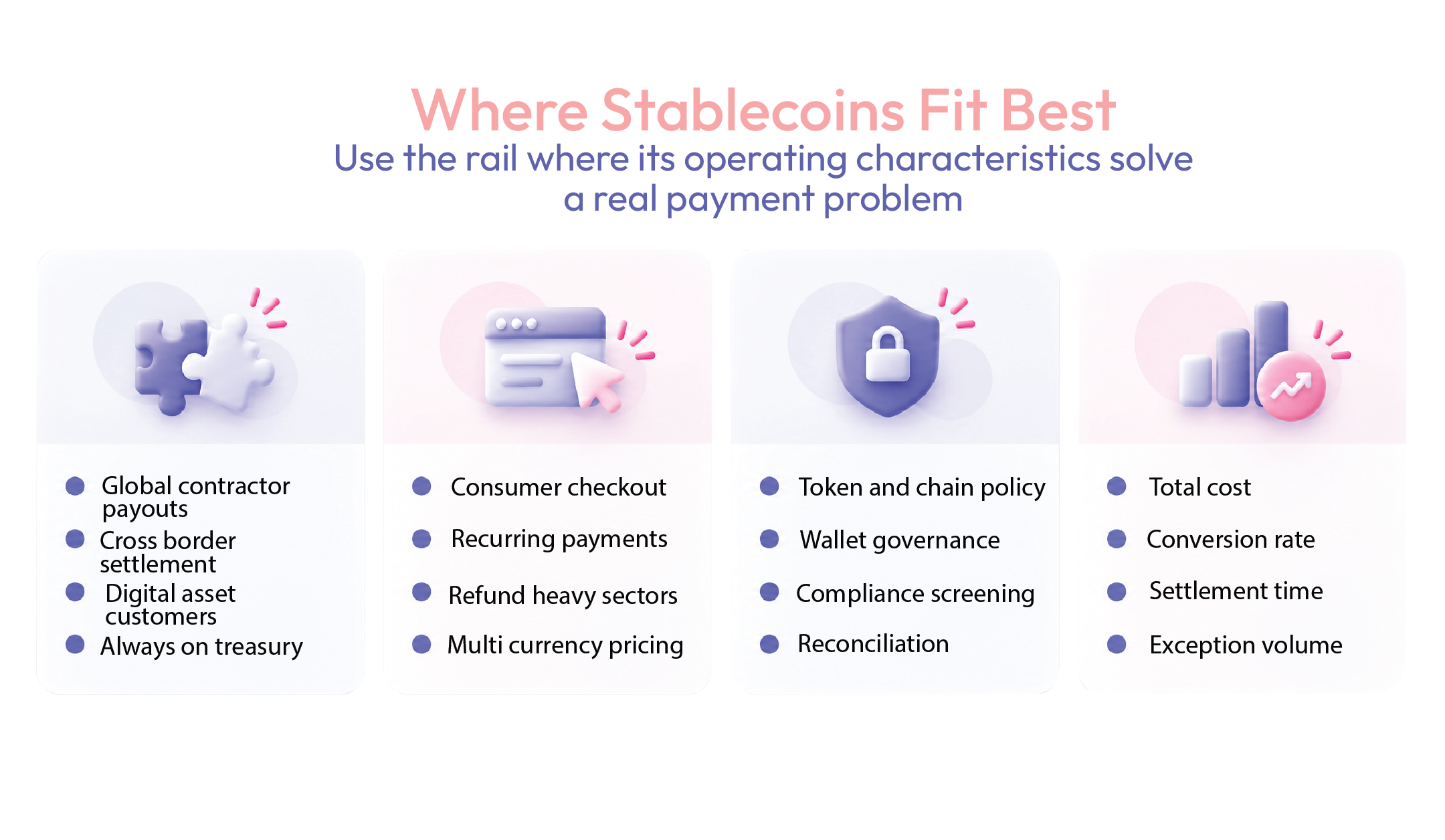
Cross border settlement Stablecoins can reduce dependence on correspondent banking paths and bank operating hours when both ends of the flow have reliable conversion and liquidity.
Digital asset customers Customers who already hold stablecoins can pay without first returning to fiat. The checkout benefit is weaker when a customer must acquire a stablecoin only to complete one purchase.
Global payouts Contractors, creators, affiliates and suppliers may value faster access to a dollar or euro linked asset, subject to local rules and their ability to use or redeem it.
Always on treasury Businesses operating across time zones can move eligible balances outside bank cutoffs, but they still need wallet controls, liquidity limits and approval policies.
Circle promotes stablecoin merchant settlement with continuous access to funds, including weekends. The commercial benefit depends on redemption, liquidity and the merchant operating model, not transfer speed alone. (Circle)
The Cost Must Be Measured End to End
Comparisons often place a blockchain transaction fee beside a card processing fee. That is not a complete comparison. The stablecoin flow may include checkout fees, wallet infrastructure, compliance screening, conversion spreads, liquidity costs, custody, failed payment handling and reconciliation work.
Card costs should also be measured fully, including authorization, fraud, disputes, foreign exchange, settlement and operational overhead. The correct comparison follows the same customer order to the same final outcome.
Merchants should track payment conversion, total cost per settled order, time to usable funds, refund completion, manual exception rate and customer support contacts. A lower transfer fee has limited value if more customers abandon checkout or finance spends more time explaining the result.
Why Stablecoins Need Payment Orchestration
A stablecoin provider can make the method available. Orchestration determines how it fits with the rest of the payment stack. The merchant still needs to decide when to present the method, which provider or network to use, how to monitor availability and how to compare the outcome with cards, wallets, bank payments and local methods.
A strong orchestration layer should provide:
• One checkout decision across traditional and stablecoin payment methods
• Token, network and provider rules by market and customer segment
• Normalized payment states across onchain and conventional rails
• Provider health monitoring and controlled fallback paths
• A shared transaction identifier from order through settlement
• Combined reporting for conversion, cost, risk, liquidity and reconciliation
• Auditable changes to routing and settlement policy
The aim is not to hide the differences between payment rails. It is to manage those differences through one control model so that a new method does not become a new operational silo.
Questions to Answer Before Launch
Customer demand Which customers already hold stablecoins, and what payment problem would acceptance solve for them?
Asset and network Which stablecoins and blockchains will be supported, and what happens if a customer selects the wrong combination?
Settlement Will the business receive fiat or stablecoins, in which currency, on what schedule and at what conversion cost?
Control Who holds the wallet, approves transfers, manages limits and responds to security incidents?
Compliance Which regulated entities, screening tools and jurisdictional rules apply to the proposed flow?
Customer recovery How will underpayments, overpayments, wrong network transfers, refunds and support requests be handled?
Finance Can every onchain transaction be connected to the order, fees, conversion and final bank or wallet balance?
A merchant that cannot answer these questions is not ready to add stablecoins to checkout. It may still be ready to use them for a narrower settlement or payout case with fewer customer variables.
The MoreFin Perspective
At MoreFin, we see stablecoins as another payment and settlement rail that must earn its place in the stack.
The technology can shorten movement between parties and support customers or counterparties who already operate with digital assets. Its value depends on the full design: checkout, provider choice, compliance, liquidity, conversion, refunds and reconciliation.
Merchants should not evaluate stablecoins in a separate dashboard with a separate definition of success. They should compare the method with every other route using customer conversion, total cost, settlement speed, risk and usable funds.
When the new rail shares the same orchestration and financial control layer, the business can test where stablecoins improve performance without giving up visibility or creating another manual operating process.
Conclusion Stablecoins Need an Operating Model
Stablecoins can move value quickly. Merchant payments require more than movement. They require a clear customer instruction, a supported asset and network, secure control, compliant processing, predictable settlement and records that finance can reconcile.
The strongest use cases solve a specific constraint in cross border settlement, digital asset commerce, payouts or treasury. The weakest start with the technology and search for a problem afterward.
A merchant should add stablecoins when the complete flow improves customer reach, cost, liquidity or control. The transfer may happen on a blockchain. The standard for success remains the same: the payment must work for the customer and produce explainable value for the business.
Add Stablecoins Without Adding Another Payment Silo
MoreFin helps merchants connect new payment rails with the routing, monitoring, reconciliation and financial controls already required across the wider payment stack.
Stablecoin payments can then be evaluated alongside cards, wallets, bank payments and local methods using the same commercial and operational outcomes.
Speak with MoreFin about designing a stablecoin payment flow that fits your markets, treasury model and risk requirements.
Related articles


Let’s Build the Right
Flow for You
Ready to elevate your digital payments? Our team is here to tailor a custom, high-performance infrastructure that scales with your ambitions. Let’s build your next competitive advantage - together.