
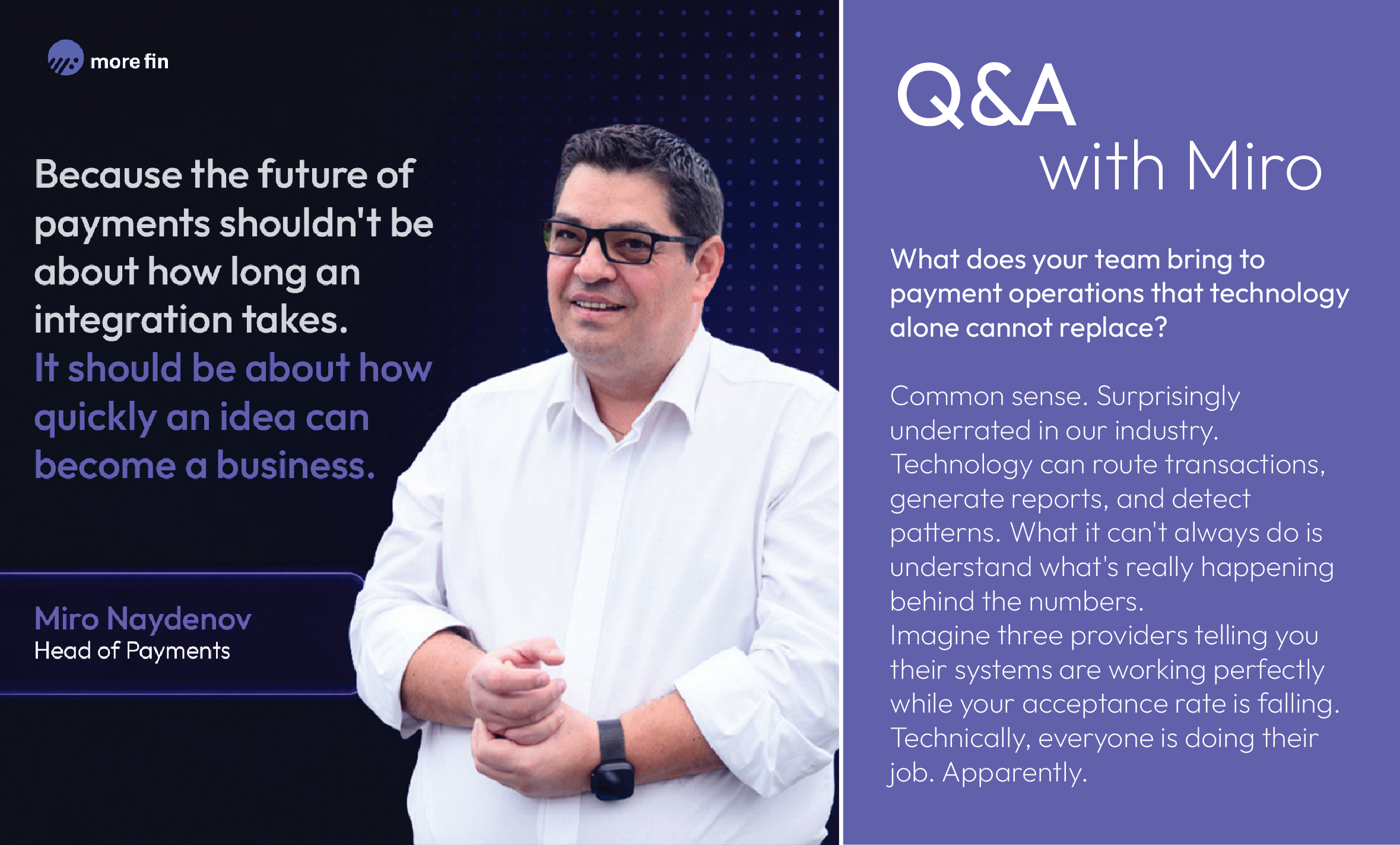
Because the future of payments shouldn't be about how long an integration takes. It should be about how quickly an idea can become a business
1. We know you as the person leading Morefin’s Payment Department but what drives and inspires you when payments are no longer on your mind?
First of all, I would love to know when that moment is supposed to happen.Jokes aside, I'm naturally curious. I enjoy understanding how things work, challenging the usual way of doing things and finding better solutions. That doesn't really switch off when I leave the office. Outside work, family, travelling, and discovering new places help me keep some perspective. I've also learned that sometimes the best way to solve a problem is to stop staring at it for a while.And as much as I enjoy payments, I do believe there's more to life than approval rates. Although my team might disagree.
2. What does your team bring to payment operations that technology alone cannot replace?
Common sense. Surprisingly underrated in our industry. Technology can route transactions, generate reports, and detect patterns. What it can't always do is understand what's really happening behind the numbers.
Imagine three providers telling you their systems are working perfectly while your acceptance rate is falling. Technically, everyone is doing their job. Apparently. That's where people make the difference. My team knows when to challenge the data, when to question a provider's explanation, and when something that looks perfectly fine on a dashboard is actually a business problem. We don't just operate payment systems. We take responsibility for the results.
3. How does your team balance increasing payment acceptance rates with minimizing fraud while maintaining security?
Everyone loves a high approval rate. Especially when nobody asks how it was calculated. At Morefin, we're interested in the numbers behind the numbers. A 95% approval rate sounds fantastic, but it tells you very little without understanding the traffic, excluded declines, fraud exposure, and actual business outcome. We use intelligent routing, multiple acquiring partners, transaction-level analysis and continuous performance monitoring to improve acceptance without compromising security. But we also understand that not every declined transaction is a failure. Sometimes declining a transaction is exactly the right decision. Our goal isn't to make the dashboard look impressive. It's to improve real payment performance while keeping the business protected.
4. Which payment operations can AI confidently automate to give your team more time for deeper analysis, strategic decisions and performance optimization?
Quite a lot, actually. And I think we're only scratching the surface. Reconciliation, reporting, anomaly detection, transaction monitoring and identifying performance deterioration are obvious starting points. Much of this work is repetitive, timeconsuming and doesn't require someone to spend hours moving numbers between spreadsheets. AI should also help us spot patterns we might otherwise miss and suggest actions before a small performance issue becomes an expensive one. But there's a difference between automating work and outsourcing responsibility. I'm comfortable letting AI analyze millions of transactions and recommend changes. I'm less comfortable letting it make unrestricted commercial or risk decisions without human oversight. My ambition is simple: less time spent preparing reports, more time spent understanding what they actually mean. And hopefully fewer spreadsheets. We have enough of those already.
5. What has been your team's biggest payment challenge and how did you turn it into a measurable success?
One of the biggest challenges has been building a payment operation that doesn't depend on everything going according to plan. Because in payments, it rarely does. Providers change their risk appetite, banks introduce new restrictions, integrations behave differently in production and sometimes a perfectly healthy payment channel suddenly stops performing. We've focused heavily on diversification, alternative routing, faster incident response and understanding performance at a much deeper level than a single approval-rate percentage. Instead of relying on one provider to fix an issue, we want to have another solution ready before the issue becomes a serious problem. We measure progress through acceptance performance, recovery of failed transactions, operational continuity and the time required to identify and resolve incidents. The biggest change has been moving from reacting to problems toward anticipating them. A provider going down is still a problem. But it shouldn't automatically become our client's problem.
6. How important are personal relationships with clients and payment partners in achieving successful payment operations?
You can have excellent technology, sophisticated routing and a beautifully written SLA. Then something breaks on Friday evening. Suddenly, the most valuable feature in your payment infrastructure is someone who actually picks up the phone. That's why I place enormous value on personal relationships. With providers, trust and direct communication often make the difference between a problem being resolved in minutes or disappearing into a support queue for hours. With clients, it's equally important. We need to understand their business, not just their transaction volumes. Their markets, growth plans, commercial pressures and what a payment failure actually costs them. I don't believe relationships can compensate for bad technology. But I know from experience that good technology without strong relationships has its limitations. Especially on Fridays.
7. What's the most ambitious challenge your team is currently working on and how could it redefine speed to market in payments?
Time to market. And I believe the industry still underestimates how important it really is. For me, speed to market isn't just an operational KPI. It's a powerful catalyst for building trust, attracting new clients, and proving that you deserve to be considered a market leader. At Morefin, we're almost obsessed with improving it. Every week, we challenge ourselves to shorten delivery times and expand payment coverage across both established and more exotic markets. Of course, technical and compliance obstacles will always exist. We don't expect them to disappear. What we're getting increasingly good at is predicting them, preparing for them, and resolving them before they turn into weeks of delays. And I can clearly see the progress. Not just in how quickly we deliver, but in how accurately we anticipate potential problems. Experience is starting to make a real difference. But our ambition goes further. Why shouldn't entering a new market or launching a new client feel like using a marketplace? Imagine having all the payment components of your business plan already available. Providers, local payment methods, routing options, compliance preparation, tested integrations, and experienced teams behind them. Ready to be selected, combined and activated according to your business needs. Morefin has already done the heavy lifting. You focus on your business strategy, your ambitions and your growth. We take care of the payment complexity behind it. That's the vision driving our team. It's what makes the constant improvements, experiments and occasionally unconventional ideas worthwhile. Because the future of payments shouldn't be about how long an integration takes. It should be about how quickly an idea can become a business.
8. What qualities do you value most in your team and how have your people influenced your approach to leadership?
Ownership. Curiosity. And the ability to think independently. I don't need people who agree with everything I say. That would make meetings shorter, but probably not very productive. I value colleagues who challenge assumptions, ask uncomfortable questions and don't accept "this is how we've always done it" as a reasonable explanation. Mistakes happen. We're dealing with complex systems, multiple partners and constantly changing conditions. What matters to me is how people respond when something goes wrong. Do they take responsibility? Do they look for solutions? Do they learn from it? My team has also taught me to delegate more and listen better. Sometimes someone closer to the daily operation sees a solution that isn't obvious from a management perspective. I want people who can make decisions, not just execute instructions. And if someone on my team comes up with a better idea than mine, that's not a challenge to my authority. That's exactly what I hired them for.
Related articles


Let’s Build the Right
Flow for You
Ready to elevate your digital payments? Our team is here to tailor a custom, high-performance infrastructure that scales with your ambitions. Let’s build your next competitive advantage - together.