
Network Tokens, PCI, and the Future of Card Payments
For decades, card payments have been built around a simple concept: the card number. Whether a customer paid online, in-store, through a subscription, or via a mobile application, the primary account number (PAN) served as the foundation of the transaction. Despite enormous innovation across the payments industry, from digital wallets and one-click checkout experiences to payment orchestration and real-time fraud prevention, the underlying credential remained largely unchanged.
Today, that is beginning to shift.
Behind the scenes, card networks, issuers, payment providers, and merchants are collectively moving toward a future where traditional card credentials become increasingly abstracted. The technology driving this transformation is network tokenization. While many payment leaders still associate network tokens primarily with fraud prevention and security, their impact extends much further. Network tokens are becoming a critical component of modern payment architecture, influencing everything from authorization rates and customer retention to PCI scope and operational efficiency.
As payment ecosystems become more complex and PCI DSS 4.0 pushes organizations toward reducing exposure to sensitive payment data, network tokenization is emerging as one of the most important developments in modern payments. More importantly, it is changing how payment leaders should think about the relationship between security, compliance, and performance.
The Card Number Is Becoming Obsolete
The original card number was designed for a world that no longer exists. When payment cards first became mainstream, transactions were relatively simple. A customer presented a card, a merchant processed the transaction, and the payment ecosystem operated within a predictable framework. Today, however, payment credentials move across websites, mobile applications, subscription platforms, digital wallets, marketplaces, and increasingly sophisticated payment infrastructures.
Consumers expect their payment methods to work seamlessly regardless of channel or device. They expect subscriptions to renew automatically, digital purchases to complete instantly, and stored payment methods to remain available for years. At the same time, merchants are expected to deliver frictionless experiences while protecting customers from fraud and maintaining increasingly complex compliance obligations.
Traditional card credentials create challenges for everyone involved. Cards expire. Cards are reissued. Fraud events trigger credential replacements. Banks upgrade card products. Customers replace lost or stolen cards. Every one of these events creates friction in the payment ecosystem because the merchant is relying on a credential that is inherently static while the underlying payment relationship is dynamic.
For years, the industry has built workarounds to address these problems. Account updater services helped merchants maintain stored credentials. Fraud prevention systems attempted to identify suspicious activity. Payment teams invested heavily in retry logic and customer recovery campaigns. Yet these solutions were ultimately designed to compensate for the limitations of the traditional card number.
Network tokenization addresses the problem at its source. Instead of relying on a static card credential, transactions are processed using a network-generated token linked directly to the issuer and managed throughout its lifecycle. The merchant continues to process payments as usual, but the underlying credential becomes more resilient, more secure, and significantly better suited to the realities of modern commerce.
This may appear to be a technical improvement, but its implications are fundamentally strategic. The card number is gradually becoming less important than the identity and relationship it represents. That shift changes how payments are managed, optimized, and secured.
Why Network Tokens Matter Beyond Security
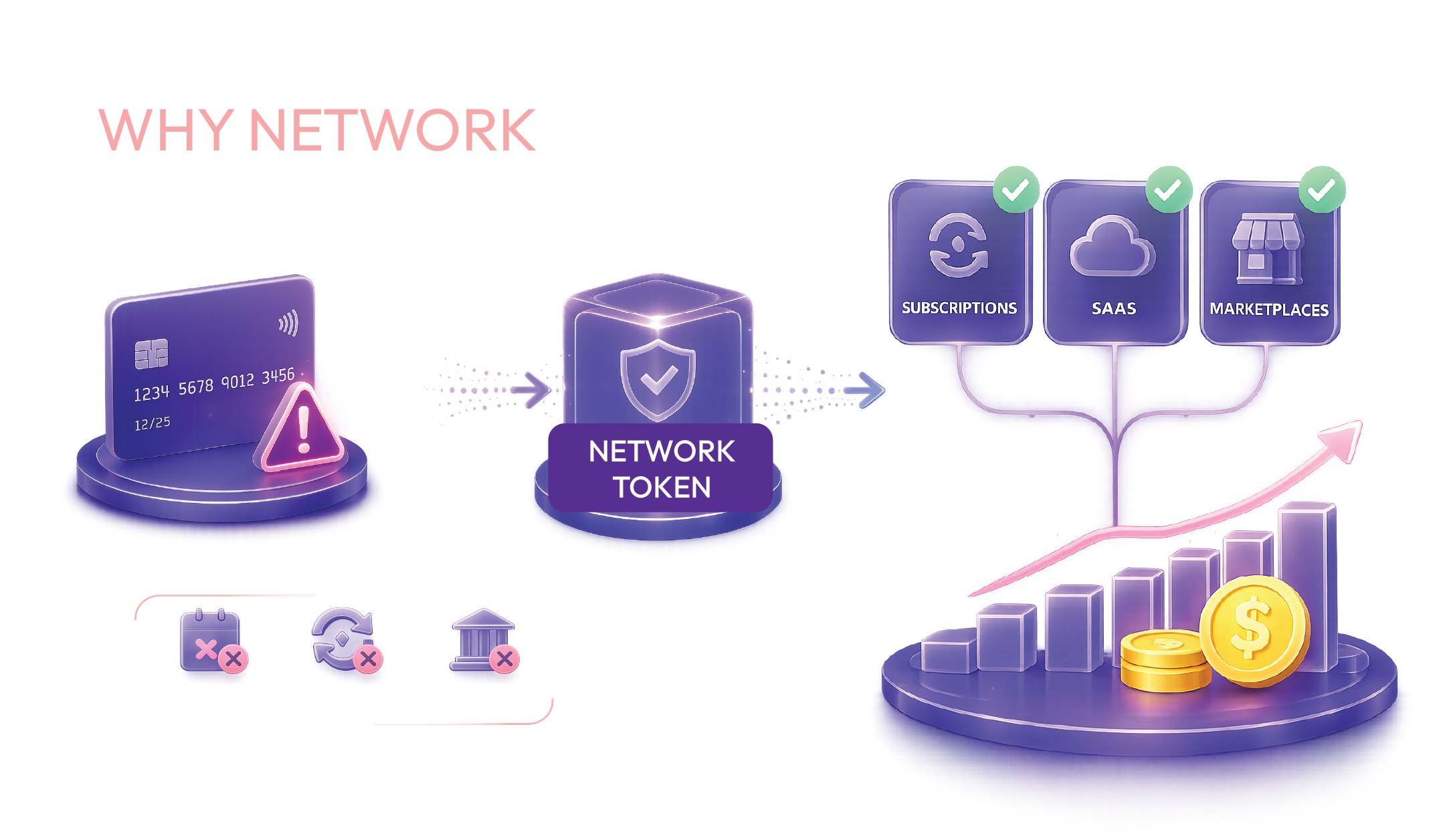
Most discussions around network tokenization begin with security, and for good reason. By replacing sensitive card credentials with network-managed tokens, merchants significantly reduce the exposure of cardholder data throughout the payment lifecycle. Even if a token is compromised, its usability is limited compared to the original primary account number. This reduces fraud risk and strengthens the overall security posture of the payment ecosystem.
However, focusing exclusively on security understates the true value of network tokens.
For many merchants, the most immediate benefit comes from payment performance. Every year, businesses lose revenue because legitimate transactions fail for reasons that have little to do with customer intent. Cards expire, are replaced after suspected fraud, or are reissued when customers receive upgraded products from their banks. Traditional stored credentials become outdated, resulting in failed recurring payments, subscription interruptions, and customer churn.
Network tokens address this challenge differently. Because they remain connected to the card network and issuer ecosystem, they can often be updated automatically when underlying card credentials change. The customer may receive a new physical card, but the token continues to function without interruption.
For subscription businesses, SaaS providers, fintech platforms, marketplaces, and iGaming operators, this capability can have a direct impact on revenue. Fewer failed transactions mean fewer involuntary cancellations. Fewer payment interruptions mean stronger customer retention. Improved authorization rates translate directly into increased revenue capture.
This is where network tokenization becomes particularly interesting for payment leaders. What begins as a security initiative quickly becomes a performance initiative. The technology does not simply reduce risk; it helps preserve revenue that would otherwise be lost through failed payments and outdated credentials.
As competition intensifies and customer acquisition costs continue to rise, protecting existing revenue streams becomes just as important as acquiring new customers. Network tokens support both objectives simultaneously.
What Network Tokens Mean for PCI DSS 4.0
One of the most important themes within PCI DSS 4.0 is scope reduction.
Historically, organizations approached PCI compliance by implementing additional controls around cardholder data. Firewalls were added. Monitoring systems were expanded. Security procedures became more sophisticated. While these controls remain important, PCI DSS 4.0 reflects a broader shift in thinking. The conversation is increasingly moving from how to protect sensitive data toward how to reduce exposure to sensitive data altogether.
This distinction matters.
Every system that stores, processes, or transmits cardholder data expands PCI scope. Larger PCI environments create greater compliance obligations, higher operational costs, more complex audits, and increased security risk. Over time, organizations often discover that managing PCI scope becomes one of the most significant operational challenges within their payment ecosystem.
Network tokenization aligns naturally with the direction PCI DSS 4.0 is encouraging organizations to move. By replacing primary account numbers with network-managed credentials, businesses reduce their direct interaction with sensitive payment data. While tokenization does not eliminate PCI requirements entirely, it supports broader efforts to simplify payment environments and minimize exposure wherever possible.
The strategic significance of this should not be underestimated.
For compliance teams, tokenization can reduce complexity. For security teams, it reduces risk. For operations teams, it simplifies management. For payment leaders, it creates an opportunity to align security objectives with business objectives rather than treating them as competing priorities.
The organizations that extract the greatest value from PCI DSS 4.0 will not necessarily be those with the most sophisticated compliance programs. They will be the ones that design payment architectures requiring less compliance effort in the first place.
Why Network Tokens Are Reshaping Payment Architecture
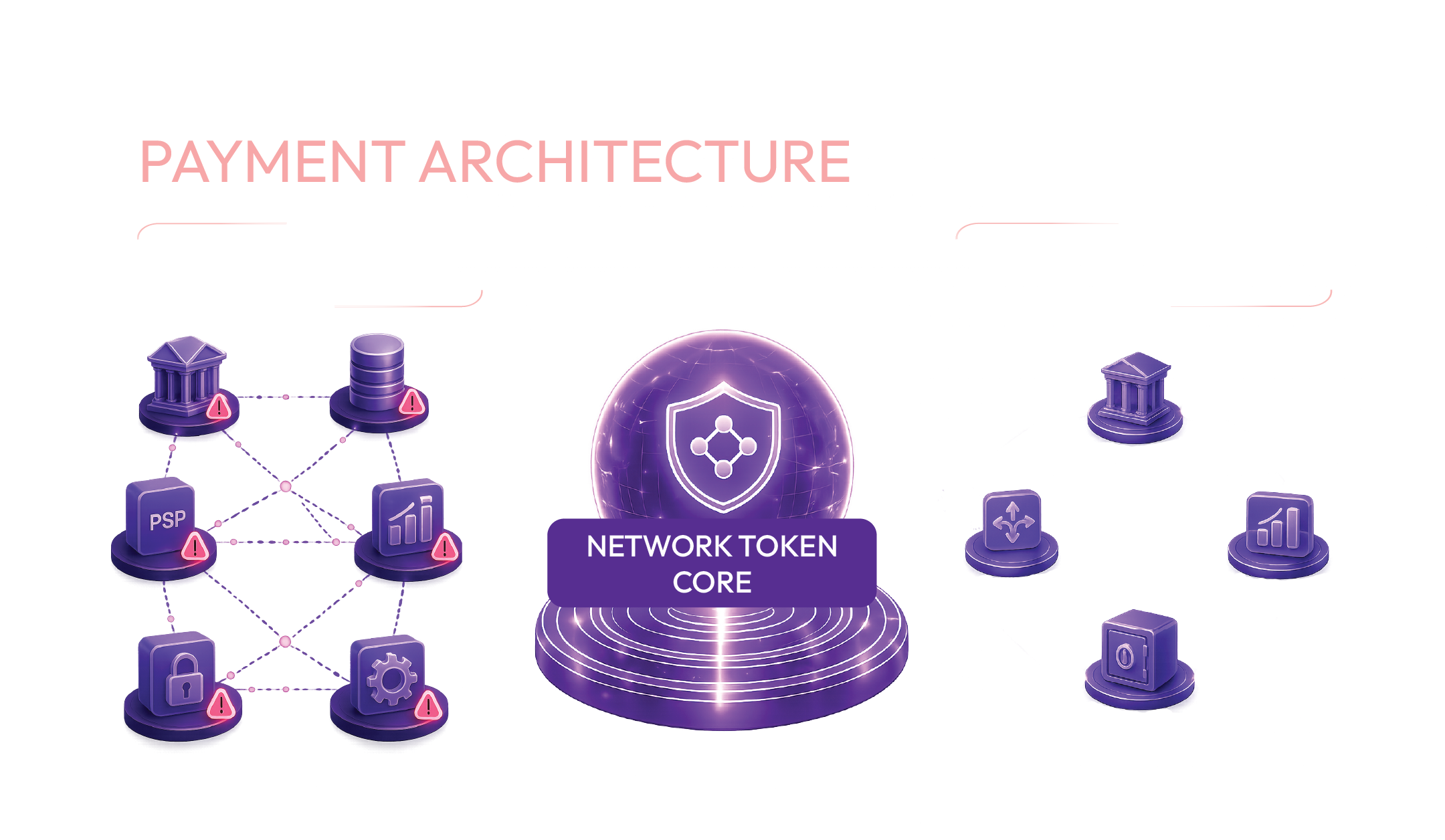
Network tokenization becomes even more powerful when viewed within the broader context of modern payment infrastructure.
Over the past decade, payment architecture has evolved significantly. Merchants increasingly rely on payment orchestration, multi-PSP strategies, token vaults, intelligent routing, and real-time payment analytics to optimize performance. The goal is no longer simply to process payments. The goal is to create payment ecosystems that maximize conversion, improve resilience, and support business growth.
Network tokens fit naturally within this evolution.
Instead of treating payment credentials as static assets stored across multiple environments, businesses can operate with dynamic credentials that are continuously managed by the card networks themselves. This simplifies credential management while supporting higher authorization rates and stronger security controls.
When combined with payment orchestration, the benefits become even more compelling. Tokenized transactions can be routed intelligently across multiple providers. Payment teams gain greater flexibility without increasing exposure to sensitive data. Operations become simpler while payment performance improves.
This represents a broader trend within the payments industry. Merchants increasingly want to focus on optimizing payment outcomes rather than managing payment infrastructure. The technologies that succeed will be those that abstract complexity while improving performance.
Network tokenization does exactly that.
Rather than adding another layer of operational overhead, it removes friction from the ecosystem. It simplifies credential management, reduces dependency on static card data, and enables more intelligent payment strategies.
The result is a payment architecture that is simultaneously more secure, more scalable, and more effective.
The Future of Card Payments Is Invisible
The most successful payment innovations are often the ones customers never notice.
Consumers do not care about PCI scope. They do not think about payment routing. They rarely consider tokenization. They simply expect payments to work whenever and wherever they choose to transact.
The future of card payments is moving toward that ideal. Payment credentials will become increasingly abstracted from the underlying card. Security controls will become more embedded within the payment ecosystem. Payment failures caused by expired cards, outdated credentials, and avoidable friction will become less common.
In this future, the card number itself becomes less important. What matters is the ability to securely identify, authenticate, and process payment credentials without exposing unnecessary risk or introducing unnecessary complexity.
Network tokenization is one of the clearest examples of this transformation already taking place.
For payment leaders, the lesson is straightforward. Network tokens should not be viewed solely as a fraud prevention tool or a compliance enhancement. They represent a fundamental shift in how payment credentials are managed and how payment ecosystems are designed.
The organizations that recognize this shift early will be better positioned to improve authorization performance, reduce PCI complexity, strengthen security, and build payment infrastructures capable of supporting future growth.
Because the future of payments is not about securing more cardholder data.
It is about creating a world where handling cardholder data becomes increasingly unnecessary.
Related articles


Let’s Build the Right
Flow for You
Ready to elevate your digital payments? Our team is here to tailor a custom, high-performance infrastructure that scales with your ambitions. Let’s build your next competitive advantage - together.