
More PSPs Can Create More Problems
Key Takeaways
- A multi-PSP strategy does not automatically improve payment performance.
- Every provider introduces another integration, data model, token environment, reporting format and operational relationship.
- Redundancy without intelligent routing is simply duplicated infrastructure.
- Provider performance must be assessed by market, issuer, method, currency and transaction type — not only through average approval rates.
- The real value of multiple PSPs comes from the decisioning layer that determines when and how each one should be used.
- Payment orchestration turns separate provider connections into a coordinated payment strategy.
The Multi-PSP Promise
The logic behind a multi-PSP strategy appears straightforward.
If one provider cannot process a transaction, send it to another. If one PSP performs poorly in a particular country, use a stronger local alternative. If an integration fails, redirect traffic elsewhere.
More providers should mean:
- Better market coverage
- More payment methods
- Higher approval rates
- Lower processing costs
- Reduced provider dependency
- Greater operational resilience
- Stronger negotiating power
These are valid objectives. For growing international businesses, depending on one provider can create significant commercial and operational risk.
But connecting another PSP does not automatically deliver these outcomes. Without unified routing, monitoring and reconciliation, every new provider adds another layer that the business must understand, manage and maintain.
PayPal describes the operational reality as merchants:
"Juggling a complex web of multiple payment platforms." (PayPal)
The problem is not the number of providers. The problem is adding providers without a control layer that makes them operate as one system.
Connectivity Is Not the Same as Control
A business may be technically connected to five PSPs while still sending most of its volume through one primary provider.
Another may distribute traffic through static percentage splits that have not been updated for months.
A third may use different PSPs for separate countries but have no consolidated understanding of their relative performance.
All three businesses have multi-provider connectivity. None necessarily has a multi-provider strategy.
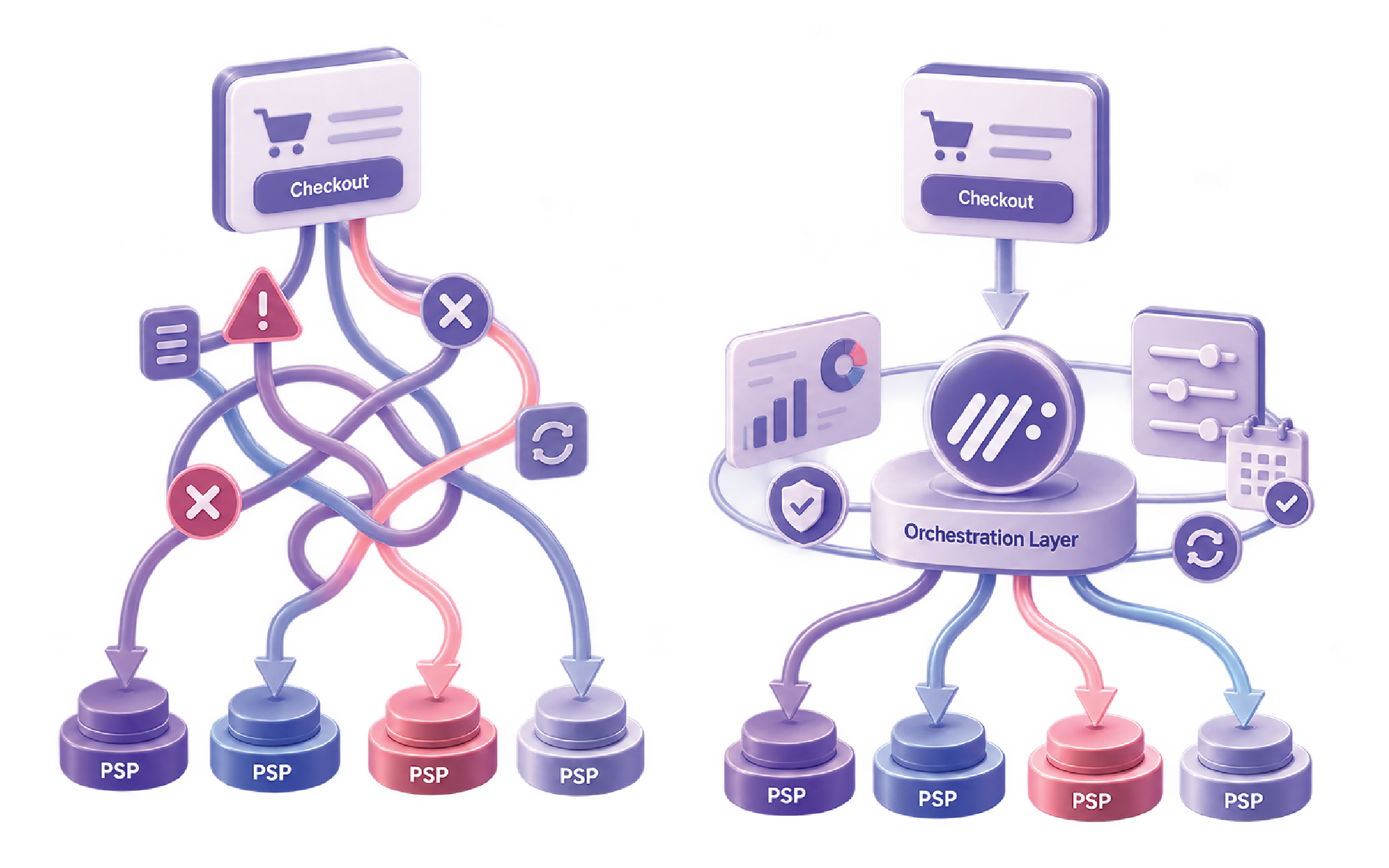
A functioning multi-PSP strategy requires the ability to answer:
- Why was this transaction sent to this provider?
- Was that provider the best choice for this customer and market?
- What should happen if the transaction fails?
- Should the transaction be retried?
- Which provider should receive the retry?
- How does the provider perform for this issuer, currency and payment method?
- What is the real cost of a successful transaction?
- Can finance reconcile the result quickly?
- Can the business change the logic without rebuilding the integration?
Connections create options. Decisioning determines whether those options produce value.
Seven Problems Created by an Unmanaged Multi-PSP Stack
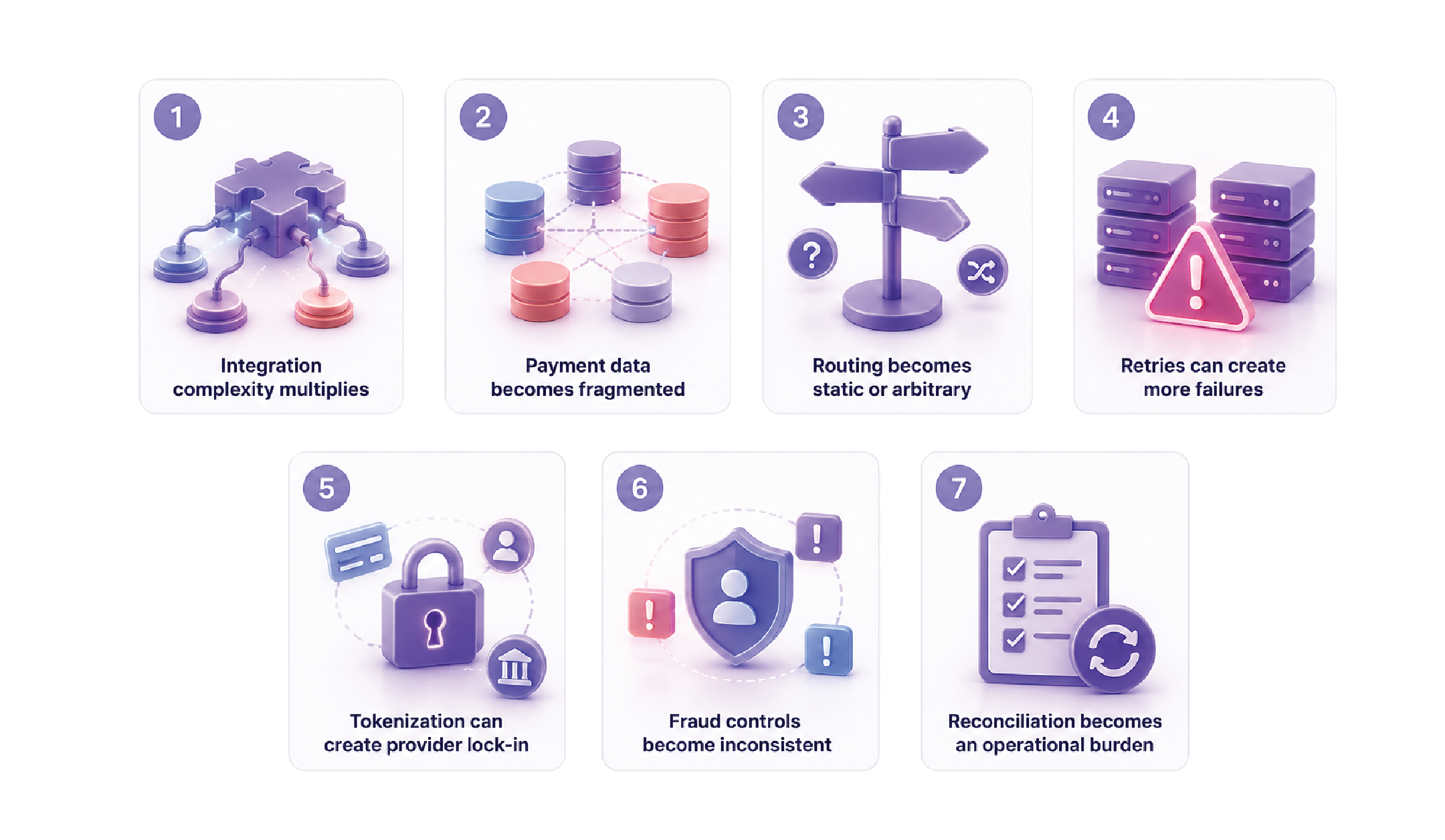
1. Integration Complexity Multiplies
Every PSP has its own API structure, authentication model, error codes, webhook formats, payment states, refund procedures, dispute workflows, reporting files, settlement schedules and maintenance requirements.
Adding a second provider does not simply duplicate the first integration. It creates a new set of exceptions.
A status called authorized by one provider may not be identical to the same status used by another. A retry that is safe through one connection may create duplication risk through another. One provider may send a webhook immediately, while another may update the transaction asynchronously.
The technical challenge is therefore not only connecting each PSP. It is creating consistent behaviour across all of them.
Without a normalized integration layer, development teams spend more time maintaining provider differences than improving payment performance.
2. Payment Data Becomes Fragmented
Each PSP presents its own version of transaction performance.
One dashboard may classify declines by issuer response. Another may combine technical and issuer declines. A third may omit details required to identify the underlying cause.
This makes apparently simple questions difficult:
- What is our real approval rate?
- Which provider performs best in Germany?
- Why did approvals fall last weekend?
- What is our cost per successful transaction?
- Which issuer is driving the increase in declines?
- How many transactions were recovered through retries?
- Are providers being compared on equivalent data?
If every provider defines and reports performance differently, teams can spend more time reconciling the data than acting on it. A multi-PSP strategy without normalized data creates multiple versions of the truth.
3. Routing Becomes Static or Arbitrary
Many businesses add providers but continue routing through simple rules — PSP A receives 70% of traffic, PSP B receives 30%, and PSP C is used only when the primary provider is unavailable. This creates distribution, but not optimization.
Provider performance changes continuously. It may differ by country, issuer, BIN range, card type, currency, transaction value, customer segment, time of day, day of the week, authentication result, merchant category and historical transaction behaviour.
A provider that performs well for UK debit cards may underperform for cross-border credit cards. A strong provider during normal conditions may experience higher latency or declining approvals during a particular period.
Static routing cannot respond intelligently to changing performance. The presence of multiple PSPs creates theoretical choice. Real-time decisioning turns that choice into a commercial advantage.
4. Retries Can Create More Failures
Retries are often presented as one of the primary benefits of a multi-PSP strategy. If a payment fails through one provider, another provider may be able to recover it. But not every decline should be retried.
A transaction may fail because of insufficient funds, invalid credentials, suspected fraud, issuer restrictions, authentication failure, technical timeout, provider unavailability, incorrect routing or duplicate-transaction protection.
Retrying a hard decline through multiple providers can increase costs, frustrate issuers and make the transaction appear suspicious. Poorly designed fallback logic may also retry through the same underlying acquirer, repeat the same authentication problem, create duplicate authorizations, generate unnecessary processing fees, increase fraud exposure, damage issuer trust and produce inconsistent customer experiences.
Effective retry logic must understand why the transaction failed before deciding what should happen next. A second PSP is not automatically a recovery path. It is useful only when the next route addresses the cause of the original failure.
5. Tokenization Can Create Provider Lock-In
Multiple PSPs may appear to reduce dependency on individual providers. Tokenization can quietly recreate that dependency.
If each PSP stores card credentials in its own vault, the merchant may end up with multiple tokens for the same customer, credentials that cannot move between providers, inconsistent card-lifecycle updates, different recurring-payment capabilities, fragmented customer histories and complex migration requirements.
This becomes especially problematic for recurring payments, subscription businesses, one-click checkout, stored credentials, merchant-initiated transactions and account updater services.
A merchant may technically have several providers but be unable to route a returning customer freely because the required credential exists only inside one provider's environment.
True provider flexibility requires a clear token and credential strategy — not just multiple processing contracts.
6. Fraud Controls Become Inconsistent
Different PSPs may apply different fraud engines, risk thresholds and authentication logic. The same customer could therefore receive different outcomes depending on the chosen route: approved through one provider, challenged through another, declined as suspicious through a third.
This creates inconsistent customer experiences and makes performance comparisons unreliable. A provider with a high approval rate may simply be accepting more risk. Another may appear to underperform because its controls are stricter.
Payment teams need to separate processing performance, issuer behaviour, authentication performance, fraud-policy decisions and merchant risk appetite.
Without a unified view, the business may route more transactions to the provider with the highest apparent approval rate while unintentionally increasing chargebacks or fraud losses. The best route is not always the one that approves the most transactions. It is the one that delivers the best sustainable outcome.
7. Reconciliation Becomes an Operational Burden
The complexity of a multi-PSP strategy continues after authorization. Each provider may use different settlement periods, fee structures, transaction identifiers, currency-conversion rules, refund reporting, chargeback processes, reserve calculations, payout files and reporting schedules.
Finance teams must connect internal orders to provider transactions, settlement batches, fees and bank movements. When this work remains manual, every new provider creates another reporting workflow and exception queue.
The result can be delayed financial reporting, unidentified settlement gaps, incorrect fee calculations, difficult refund matching, unexplained balance differences, slow month-end closing and limited visibility into provider cost.
A payment is not complete when it is approved. It is complete when the transaction is captured, settled, reconciled and correctly reflected in the financial records.
More Providers Do Not Automatically Create Resilience
Businesses often add PSPs to reduce the risk of downtime. But resilience requires more than backup connectivity.
A secondary provider creates limited protection if it uses the same underlying acquirer, depends on the same technical infrastructure, does not support the same payment methods, cannot access the customer's stored credential, cannot receive redirected traffic quickly, has failover rules that have never been tested, does not trigger real-time alerts, breaks the checkout experience during the switch, or cannot manage refunds and recurring payments consistently.
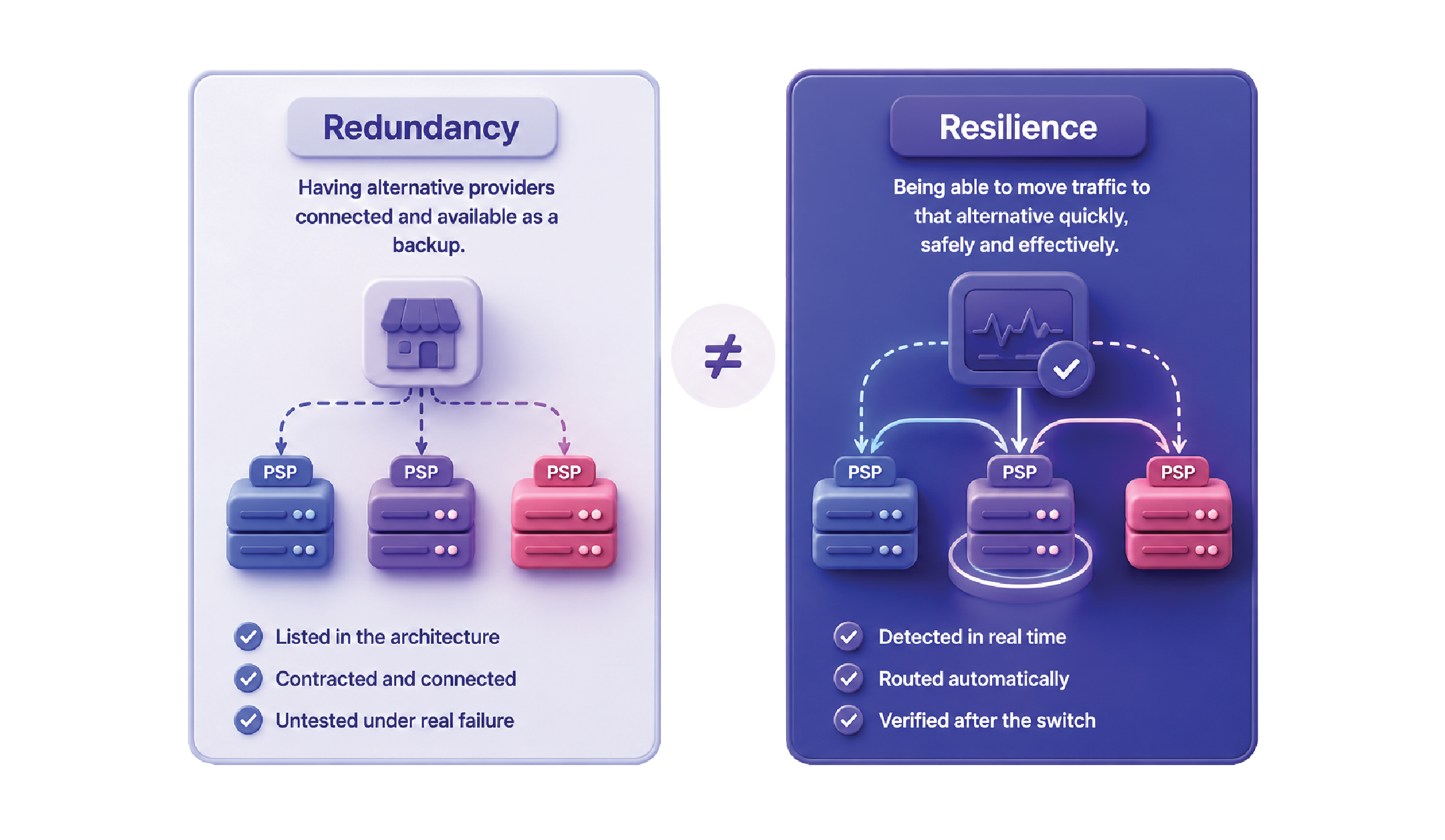
Redundancy means having alternatives. Resilience means being able to use those alternatives effectively when conditions change.
This distinction matters. A provider listed as a backup in an architecture diagram may offer little operational protection if the business cannot move traffic to it safely and immediately.
A resilient payment stack should know:
- That a provider is underperforming
- Which transactions are affected
- Which alternative route is appropriate
- Whether the alternative is operational
- How traffic should be moved
- Whether performance improved after the change
Without this capability, multiple PSPs can create a false sense of security.
When Adding Another PSP Makes Sense
This does not mean businesses should avoid multi-provider strategies. Adding another PSP can create substantial value when it addresses a specific, measurable limitation. Good reasons may include:
Entering a new market
A local provider may offer stronger acquiring relationships, relevant payment methods or better domestic approval rates.
Improving resilience
A genuinely independent provider can reduce reliance on one processing route or technical infrastructure.
Closing a coverage gap
An additional PSP may support payment methods, currencies or transaction types unavailable through existing providers.
Improving a defined segment
Performance data may show that another provider performs better for a specific issuer, region, card type or customer group.
Reducing processing cost
Alternative acquiring or routing options may reduce the cost per successful transaction.
Supporting payouts
A provider may offer stronger payout capabilities, settlement options or geographic reach.
Increasing negotiating leverage
Meaningful volume distribution can improve commercial negotiations — provided the business can move that volume in practice.
The wrong reason to add another PSP is simply because more connectivity sounds like progress. Every provider should have a defined role in the payment strategy.
Questions to Answer Before Onboarding Another PSP
Before adding a provider, payment teams should ask:
Commercial fit — What specific problem will this PSP solve? Which markets and customer segments will it serve? What measurable improvement do we expect? How will volume be allocated? What is the complete commercial cost?
Technical fit — How long will integration take? Can the PSP fit into the existing checkout? How are transaction states normalized? What webhook and reporting differences must be managed? Can existing tokens or credentials be used?
Performance — Which issuers and markets does the provider serve well? Does it offer local acquiring? How will its performance be benchmarked? Can traffic allocation change dynamically?
Risk and compliance — Which fraud controls does it apply? How does it support 3DS and SCA? How will risk policies remain consistent? What additional compliance scope does it create?
Operations — How are incidents communicated? Who owns escalation? How will provider health be monitored? What happens during partial degradation? Has failover been tested?
Finance — How does settlement work? Which fees and reserves apply? Can reports be reconciled automatically? How are refunds and disputes handled? Can finance obtain one consolidated view?
If these questions do not have clear answers, the organization may not be adding resilience. It may be adding another operational silo.
The Role of Payment Orchestration
Payment orchestration allows businesses to connect and manage multiple PSPs through a unified control layer.
Stripe defines orchestration as centralizing gateways, processors, acquirers and other financial-service providers within one platform. (Stripe)
The value, however, is not simply having one integration. A strong orchestration layer should provide:
- Unified provider connectivity
- Normalized transaction data
- Dynamic routing
- Intelligent retry logic
- Consistent tokenization
- Centralized fraud signals
- Real-time performance monitoring
- Provider-health visibility
- Automated reconciliation
- Unified reporting
- Auditable rule management
When a transaction arrives, the orchestration layer can evaluate customer location, payment method, currency, issuer and BIN, transaction value, provider availability, historical approval performance, latency, processing cost, authentication requirements, fraud risk and retry history — then select the route most appropriate for that transaction.
This is the difference between having multiple providers and operating a coordinated payment ecosystem.
From Provider Management to Payment Intelligence
The next stage of payment maturity is not adding more connections. It is learning more from every transaction and using that information to make better decisions.
A mature payment operation should continuously evaluate approval rate by provider and segment, decline reasons, cost per successful transaction, provider latency, technical-error rates, authentication performance, retry-recovery rates, fraud and chargeback outcomes, settlement accuracy and reconciliation exceptions.
This allows businesses to manage providers based on performance rather than assumptions. A provider should receive more traffic because it delivers stronger results for a specific segment — not because it was selected as the default during an integration project two years ago.
Connections have become easier to obtain. The competitive advantage comes from the intelligence governing how those connections are used.
The MoreFin Perspective
At MoreFin, we do not see multiple PSPs as the strategy. They are components of the strategy.
The real value comes from creating one payment environment in which every provider has a clear role, every transaction follows defined logic and every result improves the next decision. That requires:
- Unified connectivity
- Intelligent transaction routing
- Controlled fallback logic
- Real-time provider monitoring
- Consistent payment data
- Automated reconciliation
- Continuous operational optimization
The objective is not to send transactions to more providers. It is to send every transaction to the provider most likely to deliver the right outcome at that moment — while maintaining control over cost, risk and customer experience.
Conclusion: More Is Valuable Only When It Works as One
A multi-PSP strategy can increase coverage, flexibility and resilience. It can also create fragmented data, inconsistent customer experiences, reconciliation pressure and more points of failure.
The difference is coordination.
Without orchestration, another PSP may become another dashboard, another integration and another operational dependency. With the right control layer, multiple providers become a flexible payment network that can adapt to markets, customers and changing performance conditions.
More PSPs do not automatically create better payments. Better decisions do.
Turn Provider Complexity into Payment Performance
MoreFin helps businesses connect, manage and optimize multiple payment providers through one intelligent payment environment.
From transaction routing and fallback logic to real-time monitoring and reconciliation, MoreFin gives payment teams the control required to turn provider choice into measurable performance.
Speak with MoreFin about building a multi-PSP strategy that works as one.
Related articles


Let’s Build the Right
Flow for You
Ready to elevate your digital payments? Our team is here to tailor a custom, high-performance infrastructure that scales with your ambitions. Let’s build your next competitive advantage - together.