
Merchant of Record vs Payment Orchestration: What’s the Difference?

For years, businesses searched for a single payment provider capable of solving every challenge. Payment processing, compliance, tax management, fraud prevention, global expansion, reporting, optimization, and operational support were often expected to sit within a single relationship. The logic was understandable: fewer providers meant less complexity.
That model is rapidly disappearing.
As payment ecosystems have matured, the demands placed on payment infrastructure have expanded dramatically. International growth introduces regulatory complexity. New markets require localized payment experiences. Approval rates vary by issuer and geography. Fraud threats evolve continuously. Operational requirements become increasingly specialized. The result is a payment landscape where no single provider can realistically excel at every function.
This shift is giving rise to a more layered approach to payments, where different capabilities solve different business challenges. Merchant of Record and Payment Orchestration are two of the clearest examples of this transformation. Yet they are frequently compared as if they were competing solutions, when in reality they address entirely different objectives.
The distinction is best understood through the lens of growth. Merchant of Record helps businesses enter markets. Payment Orchestration helps businesses perform within them. One reduces the complexity of expansion. The other improves the commercial outcomes of that expansion. Understanding the difference is becoming increasingly important as payments evolve from a processing function into a strategic business capability.
Global Expansion Requires More Than Market Access
Most international growth strategies begin with a focus on market entry. Businesses evaluate tax obligations, regulatory requirements, legal structures, local payment acceptance, and operational readiness before launching into a new geography. These considerations are critical because they determine whether expansion is even possible.
However, market entry is only the beginning of the growth journey.
Once a business becomes operational within a market, a new set of challenges emerges. Approval rates, payment conversion, provider performance, routing decisions, local payment preferences, and customer experience become increasingly important drivers of commercial success. A company can successfully launch in a market while still underperforming within it. In practice, many international expansion initiatives fail to achieve their full potential not because access was unavailable, but because payment performance never became a strategic priority.
This distinction between access and performance sits at the heart of the Merchant of Record versus Payment Orchestration discussion. While both contribute to growth, they do so in fundamentally different ways.
Merchant of Record Solves the Complexity of Expansion
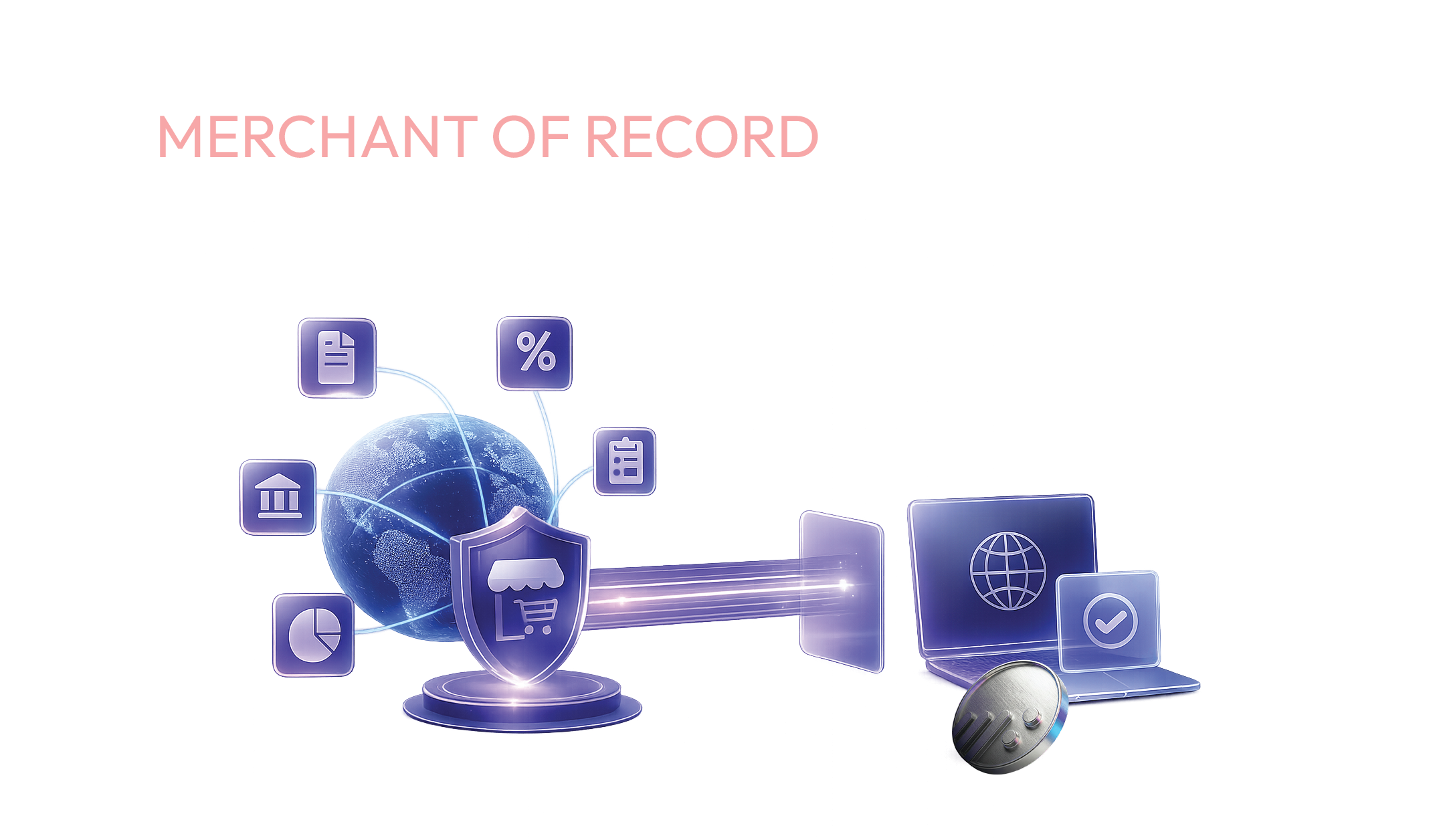
Merchant of Record exists because global commerce has become increasingly difficult to manage. Expanding into new markets requires businesses to navigate a growing web of tax obligations, invoicing standards, reporting requirements, regulatory frameworks, and compliance responsibilities. Building these capabilities internally requires substantial investment, specialist expertise, and ongoing operational resources.
The Merchant of Record model addresses this challenge by assuming responsibility for many of these functions. Acting as the legal seller of record for the transaction, the Merchant of Record manages a range of operational and compliance obligations that would otherwise remain with the merchant. This allows businesses to enter new markets more efficiently while reducing the burden associated with regulatory complexity.
For SaaS providers, subscription businesses, digital platforms, and software companies, the value proposition is compelling. Market expansion can be accelerated without building extensive internal infrastructure for tax management, compliance oversight, and local regulatory administration.
What Merchant of Record does not solve, however, is payment performance. A business may successfully launch in twenty countries while continuing to experience low authorization rates, suboptimal routing decisions, inconsistent provider performance, or avoidable payment failures. Merchant of Record simplifies expansion, but it does not optimize how payments perform once expansion has occurred.
This is where Payment Orchestration enters the conversation.
Payment Performance Is Becoming a Competitive Advantage
If Merchant of Record solves the complexity of entering a market, Payment Orchestration solves the complexity of performing within it.
Modern payment environments are fragmented by design. Merchants often operate across multiple PSPs, acquirers, fraud providers, alternative payment methods, and local payment partners. Approval rates differ between issuers. Acquirer performance varies across geographies. Customer payment preferences change by market. A payment strategy that performs exceptionally well in one region may produce entirely different results elsewhere.
Payment Orchestration introduces an intelligence layer across this ecosystem. Rather than relying on static routing logic or single-provider dependencies, orchestration platforms allow merchants to evaluate provider performance, issuer behaviour, payment methods, geographic considerations, and business rules in real time before determining the most effective path for a transaction.
The objective extends far beyond payment acceptance. Payment Orchestration exists to improve business outcomes through higher authorization rates, stronger conversion, increased resilience, and more efficient use of payment infrastructure. As payment performance becomes increasingly tied to revenue performance, orchestration is evolving from a technical capability into a strategic growth lever.
This distinction explains why the comparison between Merchant of Record and Payment Orchestration is often misleading. One addresses operational complexity. The other addresses commercial performance.
Merchant of Record vs Payment Orchestration: Key Differences

Viewed through this lens, the question is not which model is superior. Merchant of Record and Payment Orchestration solve different business challenges and therefore create value in different ways. Organizations struggling with compliance complexity, tax obligations, and market entry barriers face a fundamentally different set of priorities than those seeking to improve approval rates, reduce provider dependency, and optimize payment performance.
The more relevant question is not which solution to choose. It is which business problem requires attention first.
Why Leading Merchants Are Building Layered Payment Architectures

One of the most significant trends shaping the payments industry is the separation of operational infrastructure from performance infrastructure. Historically, businesses expected payment providers to deliver everything from processing and compliance to optimization and reporting. As payment ecosystems have matured, this expectation has become increasingly unrealistic.
Leading merchants now recognize that different business objectives require different capabilities. Tax management does not improve authorization rates. Regulatory coverage does not optimize routing decisions. Market access does not automatically translate into market performance. The most effective payment strategies therefore separate these challenges and address each with dedicated infrastructure.
In this model, a Merchant of Record may simplify expansion, compliance, and tax management, while Payment Orchestration simultaneously improves routing efficiency, authorization rates, provider resilience, and payment conversion. These capabilities are not mutually exclusive. In many cases, they become more valuable when combined because they solve different sides of the same growth equation.
This is why the conversation is increasingly shifting away from replacement and toward architecture. The question is no longer whether one capability replaces the other. The question is how both contribute to a broader payment strategy designed to support long-term growth.
The Future of Payments Is Built Around Capabilities
For much of the industry’s history, payment strategies were built around providers. Businesses selected partners based on the assumption that a single relationship could satisfy most operational and commercial requirements.
The future is moving in a different direction.
Modern payment ecosystems are becoming increasingly specialized, with capabilities such as compliance management, fraud prevention, orchestration, reconciliation, payment operations, and payment intelligence evolving into distinct layers within a broader architecture. Success will depend less on selecting the right provider and more on assembling the right combination of capabilities.
Merchant of Record and Payment Orchestration are not competing products. They are evidence of a larger transformation taking place across the industry. As payments become more strategic, infrastructure decisions are increasingly driven by business objectives rather than vendor consolidation.
The next decade of global commerce will not be defined by the companies that enter the most markets. It will be defined by the companies that build the most effective payment ecosystems within them.
Market access creates opportunity.
Market performance creates growth.
The organizations that understand the difference will be best positioned to capture both.
Related articles


Let’s Build the Right
Flow for You
Ready to elevate your digital payments? Our team is here to tailor a custom, high-performance infrastructure that scales with your ambitions. Let’s build your next competitive advantage - together.