
How to Choose a Payment Orchestration Platform
Key Takeaways
• Start with the payment constraint, operating model and measurable outcome before comparing vendors.
• A listed integration is not proof that the connector supports the required products, markets, features or service level.
• Routing matters only when teams can understand, change, approve and audit the logic safely.
• Token ownership, data access, settlement reporting and exit rights can matter more than a large feature catalogue.
• A proof of concept should use realistic payment flows, provider failures, finance exceptions and operational users.
• Compare total ownership cost, internal workload and migration risk rather than the platform fee alone.
The Selection Process Usually Starts Too Late
Many businesses begin with a vendor list. They compare connector counts, dashboards, workflow builders and claims about intelligent routing. That approach produces a feature comparison before the business has agreed on the problem.
One company may need a second acquiring route for resilience. Another may need local payment methods in new markets. A third may already have several PSPs and need consistent tokens, reporting and reconciliation. Those are different operating problems and may lead to different platform choices.
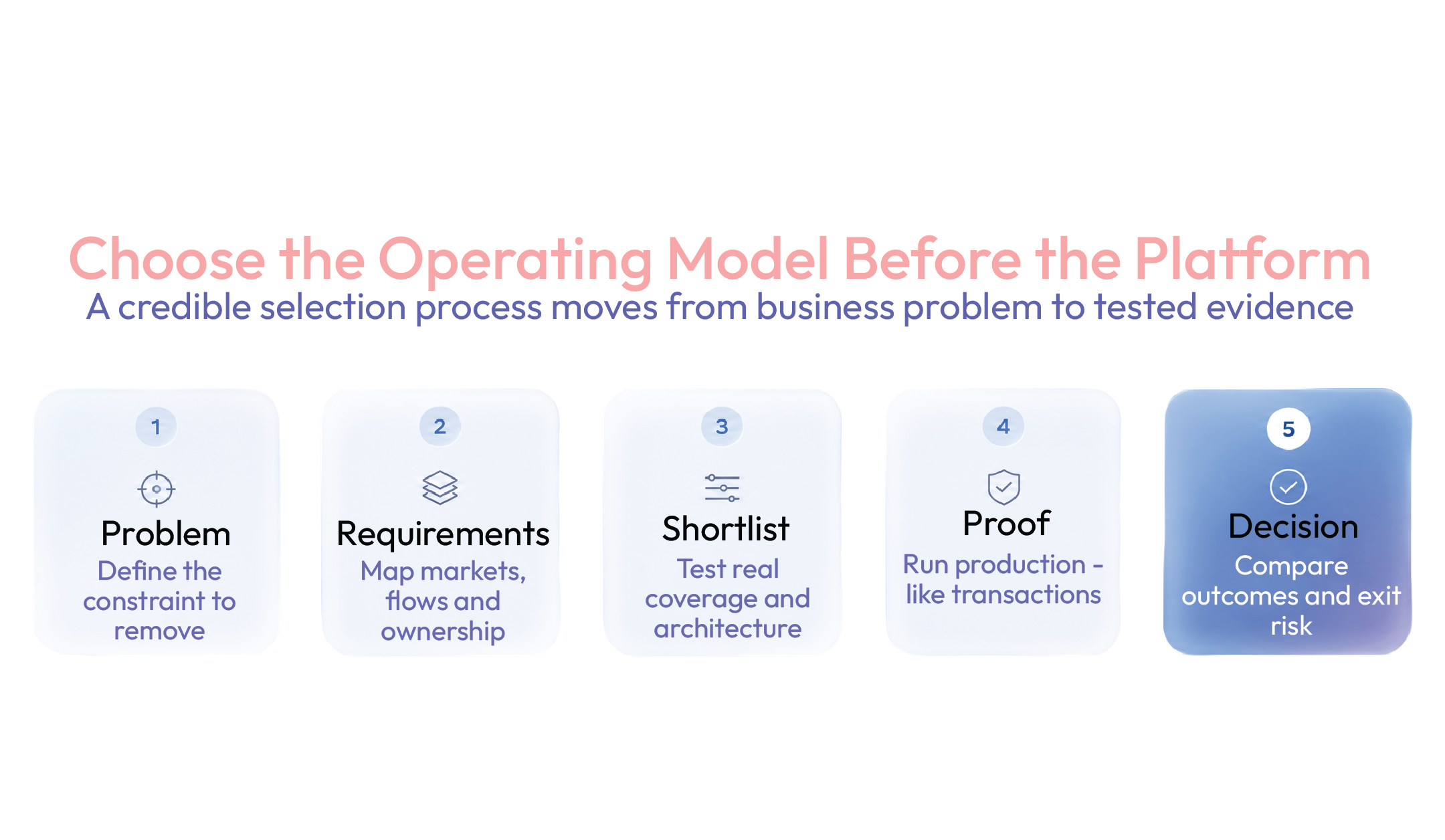
The first selection document should therefore describe the current payment flow, its constraints and the result that must improve. A vendor should be asked to solve that defined problem using the merchant's actual providers, markets and team structure.
A clear process also prevents the platform from becoming a collection of unused capabilities. Payment orchestration creates value when the organization can operate it, measure it and change decisions faster than it could before.
Define the Problem Before the Requirements
A useful requirement connects a capability to an observed constraint. Asking for smart routing is vague. Asking to divert eligible traffic within two minutes of a provider incident, with approval controls and an audit record, describes an operating need that can be tested.
The business should document where payments fail today. That may include provider outages, weak approval in specific issuer segments, slow market launches, fragmented decline codes, token lock-in, manual settlement work or engineering queues for every routing change.
Each problem needs a baseline. If the goal is resilience, record incident frequency, affected volume and recovery time. If the goal is expansion, record how long integrations and local methods take to launch. If the goal is financial control, record unmatched settlements, fee visibility and manual workload.
Without a baseline, the platform can be implemented successfully and still leave the business unable to show whether anything improved.
The Twelve Tests That Matter

1 Market and Payment Method Coverage
Coverage should be tested against the business plan, not the vendor total. Identify the countries, currencies, legal entities, customer segments and payment methods required over the next two to three years. Then confirm which connections support those exact combinations.
A platform may connect to a provider without supporting every product offered by that provider. Local acquiring, recurring credentials, payouts, network tokens, dispute data or a specific alternative method may require separate work.
2 Provider Connectivity That Works in Practice
Ask how each important connector is built, tested and maintained. Confirm supported API versions, webhooks, decline data, refunds, partial captures, reversals and settlement files. A logo on an integration page is not an implementation specification.
The evaluation should also establish who owns provider certification and what happens when a PSP changes its API. The promise of one integration has value only if the platform absorbs enough downstream maintenance to reduce the merchant workload.
3 Routing Control and Explainability
Routing should support the variables that matter to the merchant, such as issuer country, currency, transaction type, cost, provider health, authentication outcome and customer history. Rules must be understandable enough for payment teams to predict their effect.
Ask who can create and approve a change, how conflicts are resolved, when a rule becomes active and how the platform records the decision. A powerful routing engine without governance can turn payment optimization into production risk.
4 Resilience and Recovery
Failover is more than sending traffic to another provider. The system must know whether the first request reached the provider, whether another authorization could create a duplicate and whether the alternative route supports the same token and transaction state.
Test timeouts, delayed responses, partial outages and degraded provider performance. Review how the platform detects incidents and how quickly the merchant can override automatic behavior when the data is incomplete.
5 Token Ownership and Portability
Stored payment credentials can become the strongest source of provider dependency. Confirm where tokens are held, who controls the vault, which providers can use them and how credentials can be exported or migrated.
Portability should be tested contractually and technically. A promise that tokens can be moved is incomplete without the format, security process, receiving-provider requirements, timing and cost.
6 Data Access and Consistency
The platform should provide a stable transaction model across providers without hiding the original response. Payment teams need normalized statuses and decline categories; technical teams need the provider detail required to investigate edge cases.
Confirm data freshness, retention, export, API access and ownership. A dashboard can help daily operations, but it should not become the only place where the merchant can understand its payment history.
7 Settlement and Reconciliation
Authorization data is only part of payment performance. The platform should connect captures, fees, refunds, disputes, reserves, payouts and bank movements where those functions are in scope.
Ask whether reconciliation is transaction level, which provider reports are supported and how exceptions are handled. A unified authorization view with separate finance spreadsheets is only partial orchestration.
8 Fraud Authentication and Compliance
Determine whether the platform orchestrates risk tools and authentication or merely passes their results. Teams should understand how fraud decisions affect routing, retries and customer experience across providers.
Security scope, PCI responsibilities, data residency and access controls should be documented for the proposed architecture. Certifications matter, but responsibility boundaries matter more during an incident.
9 Operational Ownership
A platform should match the way the business runs payments. If operations teams own routing, they need safe self-service controls. If engineering owns changes, the APIs, testing environments and deployment process must fit existing practice.
Review permissions, approvals, version history, rollback and alerting. The selection should also identify who monitors the platform after launch and who responds when an automated rule behaves unexpectedly.
10 Engineering Experience and Observability
Developers should test the API, documentation, software libraries, sandbox behavior, idempotency, webhook reliability and error model. Production observability should make it possible to trace one order across every orchestration and provider event.
Ask how releases are communicated and how backward compatibility is managed. A fast initial integration can become expensive if the platform creates frequent unplanned maintenance.
11 Commercial Model and Total Cost
Platform pricing may include transaction fees, minimum commitments, connector charges, premium modules, support tiers and implementation services. Those costs should be compared with the engineering and operations work the platform removes.
Review incentives as well. A provider-neutral claim deserves scrutiny if commercial arrangements favor certain routes. The merchant should retain the ability to understand why traffic moved and whether the decision improved the defined outcome.
12 Exit and Continuity
Selection should include the end of the relationship. Confirm token export, data extraction, configuration records, provider contracts and the support available during migration. The contract should state what remains accessible and for how long.
A good exit plan does not assume failure. It protects the merchant's ability to change architecture as markets, volumes and internal capabilities evolve.
Build the Shortlist Around Architecture
Orchestration platforms do not all take the same role. Some provide a neutral control layer across merchant contracts. Some combine orchestration with acquiring or processing. Others focus on connectivity, checkout workflows, tokenization or a particular region.
The shortlist should reflect the desired architecture. A merchant that wants to preserve direct PSP relationships will evaluate independence differently from a business that wants one commercial provider. Neither model is universally correct. The question is which responsibilities the merchant wants to own.
Current buyer guides consistently emphasize fit by market, architecture, provider coverage, routing, token control and operational model rather than a single universal ranking. (Solidgate)
ACI Worldwide similarly describes orchestration as the layer that handles routing, connectivity and operational logic across downstream payment services. (ACI Worldwide)
Run a Proof of Concept That Can Fail
A polished demonstration shows the intended path. A useful proof of concept tests the difficult paths that determine operational trust.

Use a limited set of high-value scenarios with clear pass criteria. Route the same transaction class through more than one provider. Trigger a timeout. Change a rule with the people who will operate it. Trace a refund and settlement record. Export the data. Test the permissions and audit log.
The proof should also measure effort. Record how much vendor assistance was required, which changes needed engineering and how long an investigation took. A capability that works only with the implementation team in the room may not be operationally ready.
Use a Weighted Decision Scorecard
A scorecard should reflect business priorities rather than give every feature equal weight. A global merchant may place more weight on acquiring reach and local methods. A subscription business may prioritize credential portability and recovery. A regulated operator may weight auditability, data residency and change control more heavily.
Separate evidence from promises. Mark whether each requirement was demonstrated, contractually committed, scheduled for development or merely discussed. A roadmap item should not receive the same score as a production capability.
Keep commercial and delivery risk visible beside the functional score. The highest feature score may still be the wrong choice if migration is uncertain, internal ownership is unclear or the contract creates a new form of lock-in.
Questions to Ask Before Signing
Coverage Which required provider features are live today, and which depend on custom work or the roadmap?
Control Can our team change routing safely, approve changes, roll back and explain which rule handled a transaction?
Data Do we own and export normalized and original provider data without relying on the dashboard?
Tokens Can stored credentials be used across providers and migrated if the relationship ends?
Finance Can payment activity be connected to fees, settlements and reconciliation exceptions?
Operations Who monitors connectors, responds to incidents and maintains downstream provider changes?
Commercials What is the complete cost at expected volume, including modules, support, implementation and minimums?
Exit What data, tokens and configurations can we recover, in which format and under what timeline?
The MoreFin Perspective
At MoreFin, we believe an orchestration platform should be selected against the operating reality of the merchant.
The platform must work with the providers, markets, payment methods, risk tools and finance processes already in scope. It should also give the business room to change those choices without rebuilding the entire payment layer.
The strongest evaluation follows a transaction from checkout through routing, provider response, capture, settlement and reconciliation. It tests the people and controls around that transaction as seriously as the technology.
That is how buyers distinguish genuine control from an attractive interface. The right platform should reduce dependency, shorten response time and make payment outcomes easier to explain.
Conclusion Choose for Control and Change
Payment orchestration is a long-term operating layer. The selection should not be driven by the largest connector catalogue or the most impressive demonstration.
Start with the constraint. Define the architecture and ownership model. Test the connectors, routing, tokens, data and finance flows that matter. Measure the work required to operate the platform after launch. Protect the ability to migrate later.
A strong platform gives the merchant more options without creating more confusion. It should make payment decisions easier to change, easier to govern and easier to connect to the commercial outcome.
Choose a Platform That Fits the Payment Operation
MoreFin helps businesses assess orchestration against their real providers, markets, routing rules, finance processes and operational responsibilities.
The result is a selection based on tested control and measurable outcomes rather than connector counts or a polished demonstration.
Speak with MoreFin about evaluating the payment architecture your business actually needs.

Let’s Build the Right
Flow for You
Ready to elevate your digital payments? Our team is here to tailor a custom, high-performance infrastructure that scales with your ambitions. Let’s build your next competitive advantage - together.